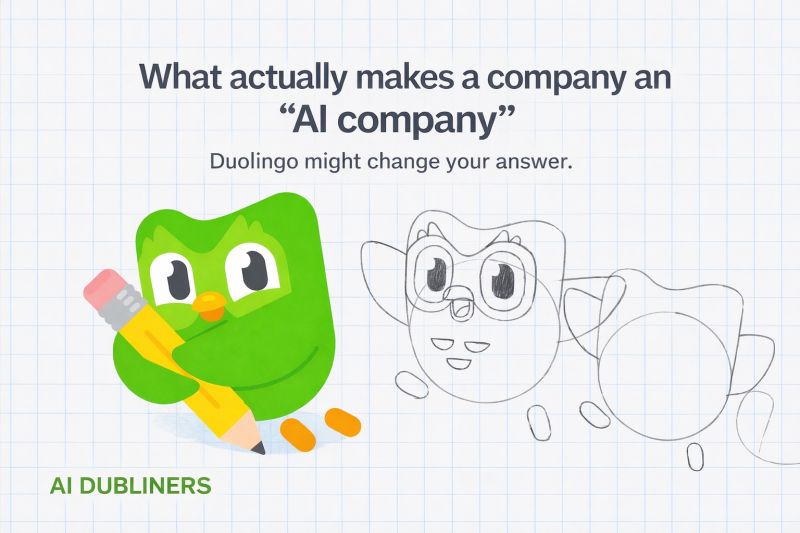
What actually makes a company an “AI company”?
That question keeps coming up at AI Dubliners, and Duolingo is one of the most useful examples for thinking it through.
At first glance, Duolingo seems easy to classify as an AI-powered company. It is a well-known education platform with AI layered into the product. But once you look more closely at how Duolingo Max changes the learning experience, that classification starts to feel less fixed.
With Duolingo Max, learners can do more than complete standard exercises and receive static feedback. They can have dynamic conversations through Video Call, practice in interactive Roleplay scenarios, and receive context-aware explanations through features like Explain My Answer.
That matters because these are not just small add-ons.
They point to a different kind of interface for learning.
The experience is no longer only about completing exercises and checking whether an answer is right or wrong. It is increasingly about interacting with an intelligent system, exploring mistakes in context, and learning through responsive feedback that adapts to the moment.
That is where the classification becomes more interesting.
If AI is simply enhancing the product, then Duolingo can still be seen as AI-powered. But if AI is starting to sit at the center of the user experience, reshape how value is delivered, and redefine the product’s learning loop, then the company may be moving closer to something that looks AI-native.
This is why the distinction matters.
Not because every company must fit perfectly into one label, but because companies are no longer standing still. They can move between categories as AI becomes more central to how the product works and how value is created.
Duolingo is a strong example of that shift.
It suggests that the better question may not be what a company is today, but what it is becoming.
For AI Dubliners, that offers a more useful lens for analysing companies across the market. The real story is not only whether AI is present. It is whether AI is supportive, central, or increasingly directive in the product itself.
So where does Duolingo sit today?
AI-powered, or already becoming AI-native?


