Back in March, ahead of the 98th Academy Awards, I asked a question on AI Dubliners: “Could a film made with AI win an Oscar?” It might have sounded speculative at the time. But I genuinely meant it.
Because the relationship between cinema and artificial intelligence is no longer a trend you watch from the sidelines. It is already inside the creative process itself. And as it turned out, Oscar night this year brought some unforgettable moments for Ireland — moments that changed how I think about AI filmmaking in Dublin and across the country.
An Oscar night that belonged to Ireland
Kerry-born Jessie Buckley won Best Actress for her role as Agnes in Hamnet, becoming the first Irish actress ever to win in that category. It was not just a personal triumph. It was a historic moment for Irish cinema.
When she reached the stage, one of the first things she said was: “This is really something.” Then she turned to her family, her Irish family sitting in the audience, and delivered her line perfectly: “Ireland bought them flights.”
That same night, Richard Baneham from Tallaght, Dublin, won Best Visual Effects for Avatar: Fire and Ash. It was his third Oscar, following wins for the original Avatar in 2009 and The Way of Water in 2023. In his acceptance speech, he said “go raibh míle maith agat,” bringing his roots right up onto that stage.
Two different disciplines. Two different creative worlds. But the same island.
How AI is reshaping the cinema conversation
Watching all of this, I kept thinking: Ireland is no longer just exporting stories to world cinema. It is exporting technical mastery, creative courage and emotional depth.
And right in the middle of this shift, the question of how AI fits in is becoming increasingly critical.
The Academy is paying attention too. The updated Oscar rules clarified that generative AI and similar tools neither automatically help nor hurt a film’s chances of nomination. What matters is how central human creative intent was to the work.
That is an important threshold. Because the conversation has moved from “was AI used?” to “who held the creative vision, and what did they make?”
Some of the films that won Oscars in 2025 had already used AI tools in small ways, particularly in sound. They were not fully AI-generated. But the line is slowly shifting. Documentaries like The AI Doc: Or How I Became an Apocaloptimist (2026) show how fast this space is maturing.
I would not be surprised if a fully AI-driven film receives an Oscar nomination within the next 3 to 5 years. We may even see an AI-themed film on the 2027 Oscar stage.
So where is the next AI-made Oscar contender taking shape right now? I think part of the answer was in Dublin. In April.
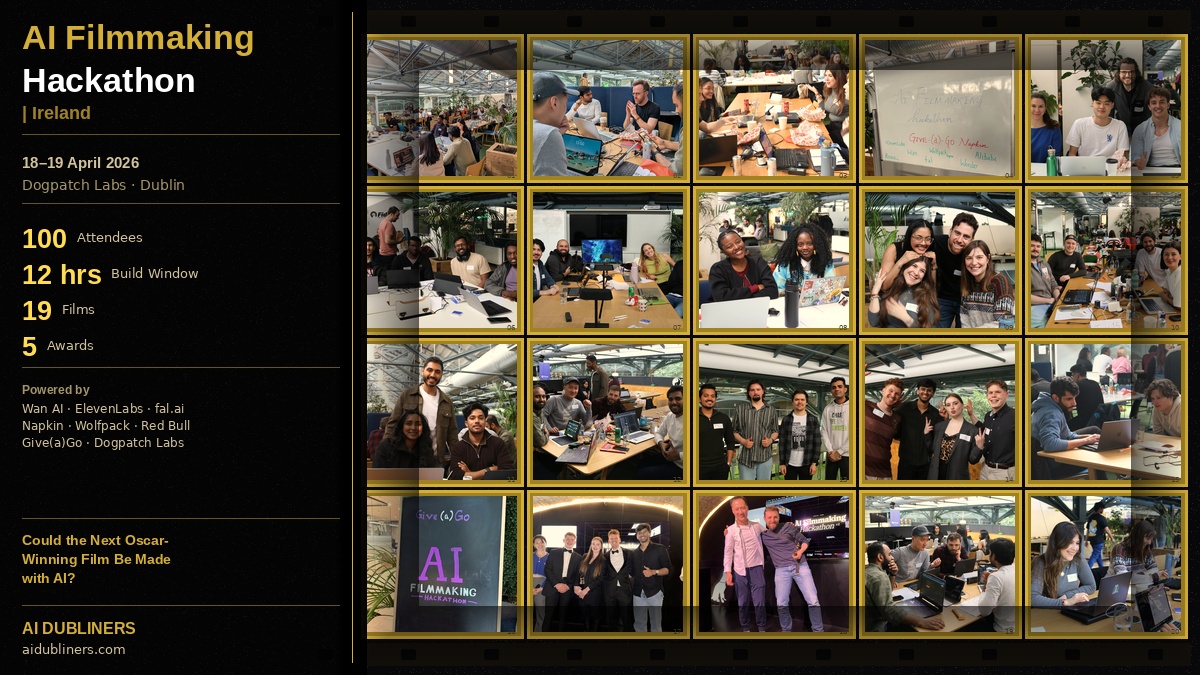
Ireland AI Filmmaking Hackathon: 100 participants, 12 hours, 19 films
On 18–19 April 2026, 100 participants came together at Dogpatch Labs in Dublin with one purpose: to make short films using AI tools. The event was organised by Give(a)Go and Napkin, with support from Wan AI, ElevenLabs, fal.ai, Wolfpack Digital, Wonder Studios and Red Bull.
This was not just a technology meetup. It was a vision made practical.
There are plenty of people talking about AI filmmaking. But here, making came before talking. In the same room: actors working alongside researchers, editors debating ideas with startup founders, storyboard artists sharing tables with machine learning engineers. Most of them did not know each other that morning. By evening, there were 19 films.
Films that did not exist at breakfast.
That is what I find genuinely remarkable. Because it does not just show how fast the technology is moving. It shows how quickly creative people can find a shared language when the right environment is built around them.
Maybe the person who will write, direct or edit the next AI-made Oscar contender was sitting at a table in Dogpatch Labs that day. And honestly, the fact that it would be in Dublin makes that an even better story.
Who was in the room?
Participants came from across Europe: filmmakers, artists, designers, engineers and creative technologists all under one roof. People whose work has touched productions like Netflix, Prime Video and Game of Thrones were in that room.
For me, the meaning is clear. The future of AI cinema will not be shaped by whoever uses the tools fastest. It will be shaped by people who truly understand the craft. People who think about framing, rhythm, sound, narrative and emotion together.
And most importantly, people who showed up early.
How the two days unfolded
Day 1 — Create
Teams formed, ideas took shape, and work began. Writing, storyboarding, AI generation, shooting, editing, iterating — all in real time.
Dogpatch Labs transformed for a day into something closer to a set, a studio and an edit suite all at once. Shooting spaces, editing corners and a live coffee bar ran throughout. Everyone was building something in the room, in real time.
Day 2 — Premiere
From production mode to screening mode. The films were shown in a cinema setting, in front of a real audience.
The jury brought together voices from both the creative and technical worlds. The night ended with an award ceremony.
This was not just a hackathon. It was a stage where a new form of storytelling was being taken seriously.
Awards and winners
The awarded films reflected the full aesthetic and creative range of the event. And there is something important to highlight here: what was celebrated was not simply “having used AI.”
What was celebrated was building narrative, generating emotion, constructing an aesthetic world, and leaving a mark.
That is the whole point.
Best Film — Sidetracked The Side Quest. A film about making a film about making a film. A layered, self-aware and genuinely creative piece. By Wilke-Mari Hamman, Herman du Toit, Paul Murnane and William Moore. Presented by Wan AI.
Best Use of Sound — Side Quest. A film that treated sound not as a supporting element but as one of the core carriers of the story. By Wojciech, Yifei, Amaan and Ash. Presented by ElevenLabs.
Best Use of AI — Rerouting. An approach where AI tools felt like a natural extension of creative thinking rather than a layer on top of it. By Anastasia Roznovan, Andriy Babiy, Max Trigub and Kai Hosokawa. Presented by fal.ai.
Best Direction — Microdosing. A film that stood out for its tonal control and directorial sensibility. By Vansh Chandra, Adam, Diarmuid and Yeva.
Community Choice — Still Becoming. A film that explored identity, pressure and transformation with visual and emotional conviction. By Kene Chukwu, Princess Nwedo, Temi Opejin and King Mbachu. Presented by Give(a)Go.
Why AI filmmaking in Dublin matters
For me, this hackathon was not just a well-organised event. It was a signal.
Ireland has long been known as one of Europe’s key hubs for global technology companies. But this event showed something different: Dublin is no longer just a city that hosts technology. It is becoming a city that experiments with it creatively, tests it seriously and turns it into culture.
When Jessie Buckley stood on that stage with everything she felt, when Richard Baneham showed the world his craft for a third time, and when 19 films came out of a single day at Dogpatch Labs, I saw different sentences of the same story: this island can hold art and technology in the same hand without dropping either one.
That matters. Because when new creative spaces emerge, the cities that move first do not just use the tools. They shape the language, the culture and the standards of that space. Dublin moving early here is a real advantage for Ireland.
A thank you to the ecosystem
Every event like this depends on people who believe in it before it exists.
To Wan AI, for pushing the ceiling on what cinematic AI video can be. To ElevenLabs, for putting the creative potential of sound at the centre of this space. To fal.ai, for making real-time AI media production actually possible. To Wolfpack Digital and Wonder Studios, for their support. To Napkin, for owning this vision in Dublin with real creative energy. To Dogpatch Labs, for opening that space in the CHQ Building. To Red Bull, for keeping the energy alive across both days. And to Give(a)Go, for bringing these people, these tools and this vision into the same room, across more than 30 events and 1,500+ attendees.
These things do not happen alone. They need an ecosystem. They need will. They need taste. And most of all, they need the desire to build something together.
AI Dubliners is here
At AI Dubliners, we do not just follow companies. We follow what companies are building with AI, how creative industries are being transformed by these tools, and how AI is touching every part of our lives — from film and sound to design, education, health and finance.
Because the story is not just about technology. It is about where technology takes culture.
The next Oscar contender might be an AI film. And that film’s story may have already begun in Dublin.
We are here. We will keep watching, writing and documenting.
Source check references