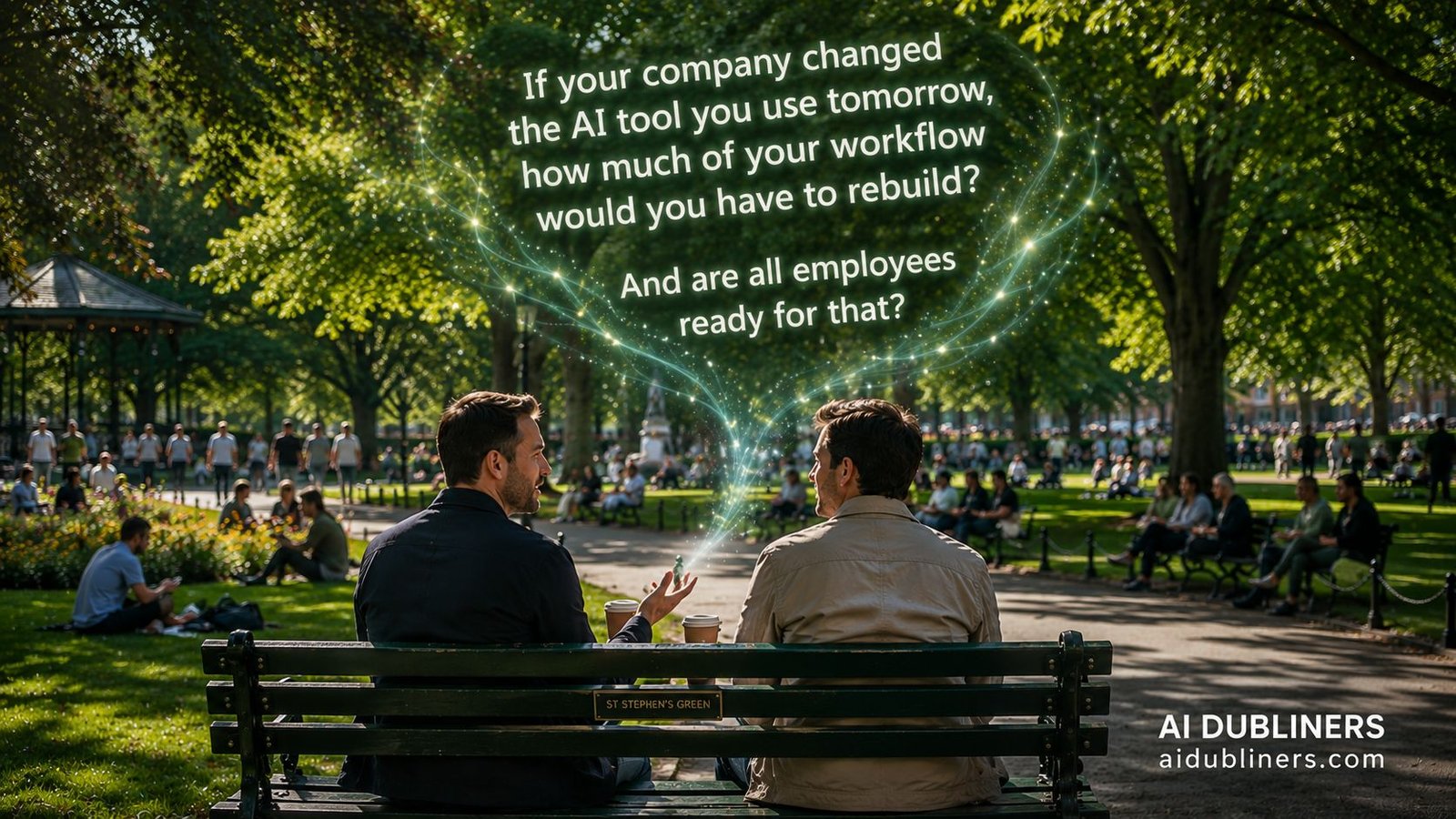
Over the weekend, I was talking with a friend when a simple question came up that stayed with me.
The company he works for supports the use of ChatGPT and has shaped much of its workflow around it. Over time, he has also built his daily tasks, prompts and working habits around the same AI tool.
So I asked him:
What happens if your company switches to another AI provider tomorrow?
This is becoming an increasingly important question for businesses adopting artificial intelligence.
What Is AI Vendor Lock-In?
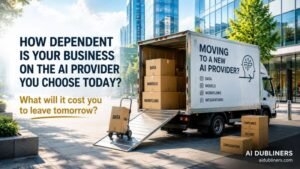
The AI industry is already discussing the risk of AI vendor lock-in, where organisations become heavily dependent on a particular AI provider, model or ecosystem.
According to IBM’s 2026 study of 1,000 executives, 71% said it would be difficult to switch their primary AI provider or model.
Most of this discussion focuses on technology: data, integrations, infrastructure and the cost of moving from one AI model to another.
As a result, concepts such as model portability, abstraction layers and multi-model AI strategies are becoming increasingly important for organisations.
But I think another kind of AI lock-in is emerging.
AI Lock-In Is Also About People
What happens to employees when the AI tool changes?
If someone spends months learning how to work effectively with a specific AI assistant, they are not simply learning a piece of software.
They are developing prompts, routines, shortcuts and ways of thinking around that system.
Changing AI providers therefore doesn’t only create a technical migration.
It can create a workflow migration.
Prompts may behave differently. Features may disappear. Integrations may change. Tasks that once felt natural may need to be redesigned.
This means AI adoption strategies should consider not only whether technology can move between models, but whether employees and their workflows can move with it.
From Model Portability to Workflow Portability
As companies adopt more AI tools, I think workflow portability will become an increasingly important part of enterprise AI strategy.
Organisations may need to design AI workflows that are less dependent on one model, while employees may need broader AI skills that transfer across different tools and platforms.
The goal should not simply be learning how to use ChatGPT, Claude, Gemini or another AI product.
It should be learning how to work effectively with AI, regardless of which model sits underneath the workflow.
Because the next challenge in enterprise AI adoption may not be switching the model.
It may be helping people switch with it.
If your company changed the AI tool you use tomorrow, how much of your workflow would you have to rebuild?
And are all employees ready for that?