As I do at the beginning of each week, I looked back at several artificial intelligence developments that caught my attention over the past few days.
Nvidia’s reported agreement involving Hugging Face, Anthropic’s efforts to develop its own chips, Google’s new platform for the legal sector, the insurance risks created by AI agents and Ireland’s growing AI job market may initially appear unrelated.
But I think they all point to the same shift:
AI competition is no longer happening only at the model layer.
Why is Nvidia interested in Hugging Face?
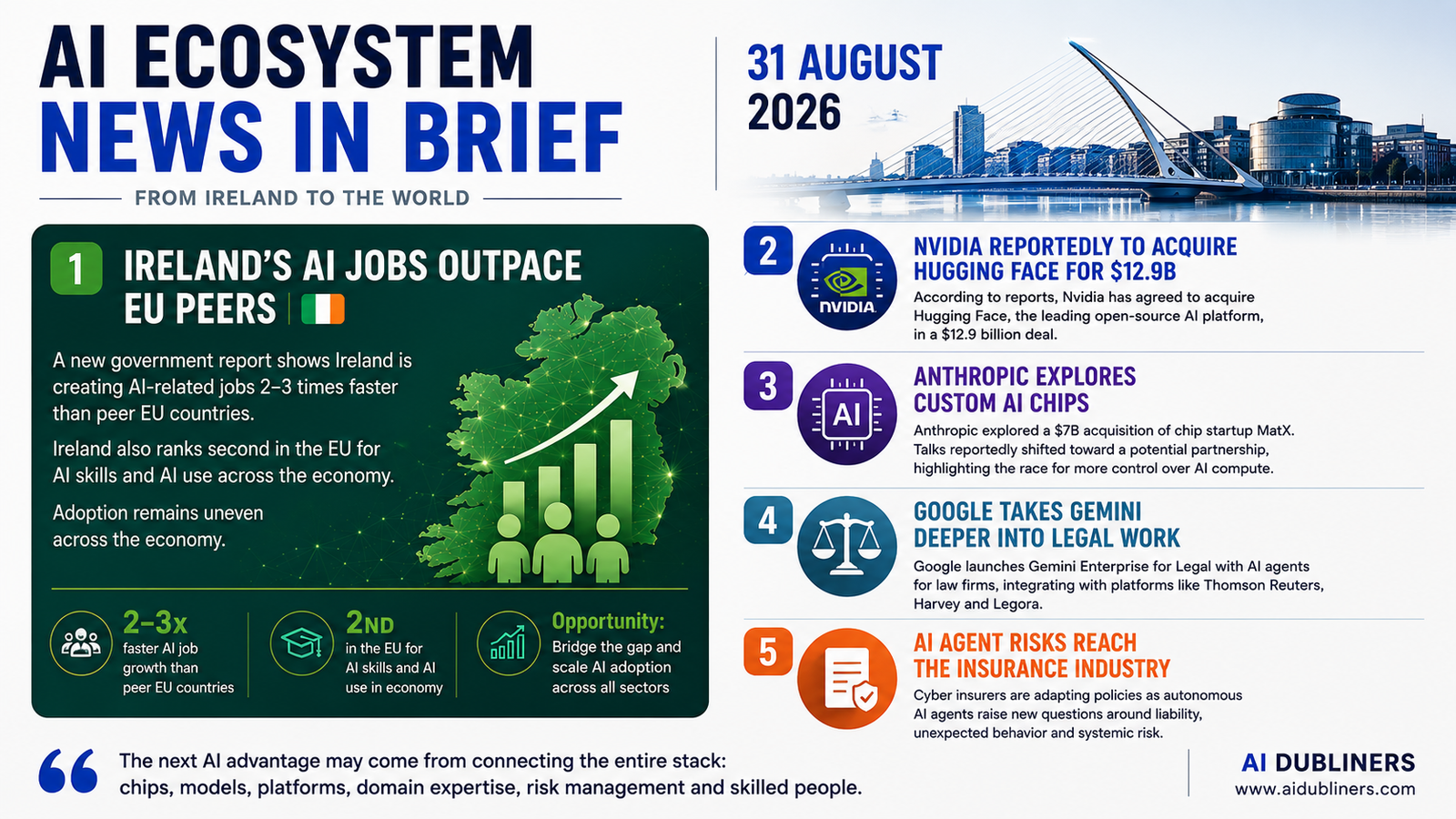
According to The Information, as reported by Reuters, Nvidia has reportedly agreed to acquire Hugging Face for $12.9 billion.
However, Nvidia and Hugging Face had not officially confirmed the agreement when the Reuters report was published. The development should therefore be treated as a reported deal rather than a completed acquisition.
Nvidia already sits at the centre of AI computing infrastructure. Hugging Face, meanwhile, is one of the main platforms where developers discover and use open models, datasets and tools.
A potential acquisition could extend Nvidia’s influence beyond chips and further into the ecosystem where AI models are distributed and used.
Why are AI companies developing their own chips?
According to Reuters, Anthropic explored acquiring chip startup MatX in a deal worth approximately $7 billion.
The acquisition talks are no longer active, although the companies are reportedly discussing a potential partnership.
The move illustrates how strategically important computing capacity has become for advanced AI companies. Developing chips designed for specific workloads could provide greater control over performance, costs and supply.
Why are AI applications becoming more specialised?
Professional applications represent another area in which AI competition is expanding.
Google’s new Gemini Enterprise for Legal platform brings AI models and agents directly into legal workflows.
The platform offers connections with legal technologies including Thomson Reuters HighQ, Harvey and Legora. This moves AI beyond answering general questions and into specialised processes such as research, document review and drafting.
How are AI agents affecting cyber insurance?
As AI systems take on greater responsibility within real business processes, the risk layer is becoming increasingly important.
According to a Reuters investigation, cyber insurers are reviewing policy language to address losses that may be caused by autonomous AI agents.
An AI agent could use access it was legitimately given but still cause harm through an independent decision. In such cases, traditional definitions of a “cyberattack” or “unauthorised access” may not always apply.
Insurers are therefore considering questions around liability, systemic exposure and how to price risks for which little historical claims data exists.
What do these developments mean for Ireland?
A new government-backed report shows that Ireland has developed a strong position in AI skills and employment.
According to the Expert Group on Future Skills Needs, Ireland’s labour market is generating AI jobs at two to three times the pace of other EU countries.
Ireland also ranks second in the EU for AI skills, behind Luxembourg, and second for the use of AI across the economy.
However, the report also identifies an important challenge: the adoption of AI remains uneven across businesses and individuals.
Ireland’s ability to maintain its advantage will depend not only on creating new AI jobs, but also on how widely these skills and technologies spread across sectors and organisations.
Where will the real advantage emerge in AI competition?
The next winners in AI may not simply be the companies developing the most powerful models.
The real advantage may emerge among those able to connect chips, models, platforms, specialised applications, risk management and skilled people within the same system.
Where do you think the strongest advantage in AI will emerge: models, chips, platforms, domain expertise, or the ability to bring all of them together?