
Artificial intelligence is often discussed through models, benchmarks and technical progress.
But one of its most urgent real-world applications is far less abstract: content moderation.
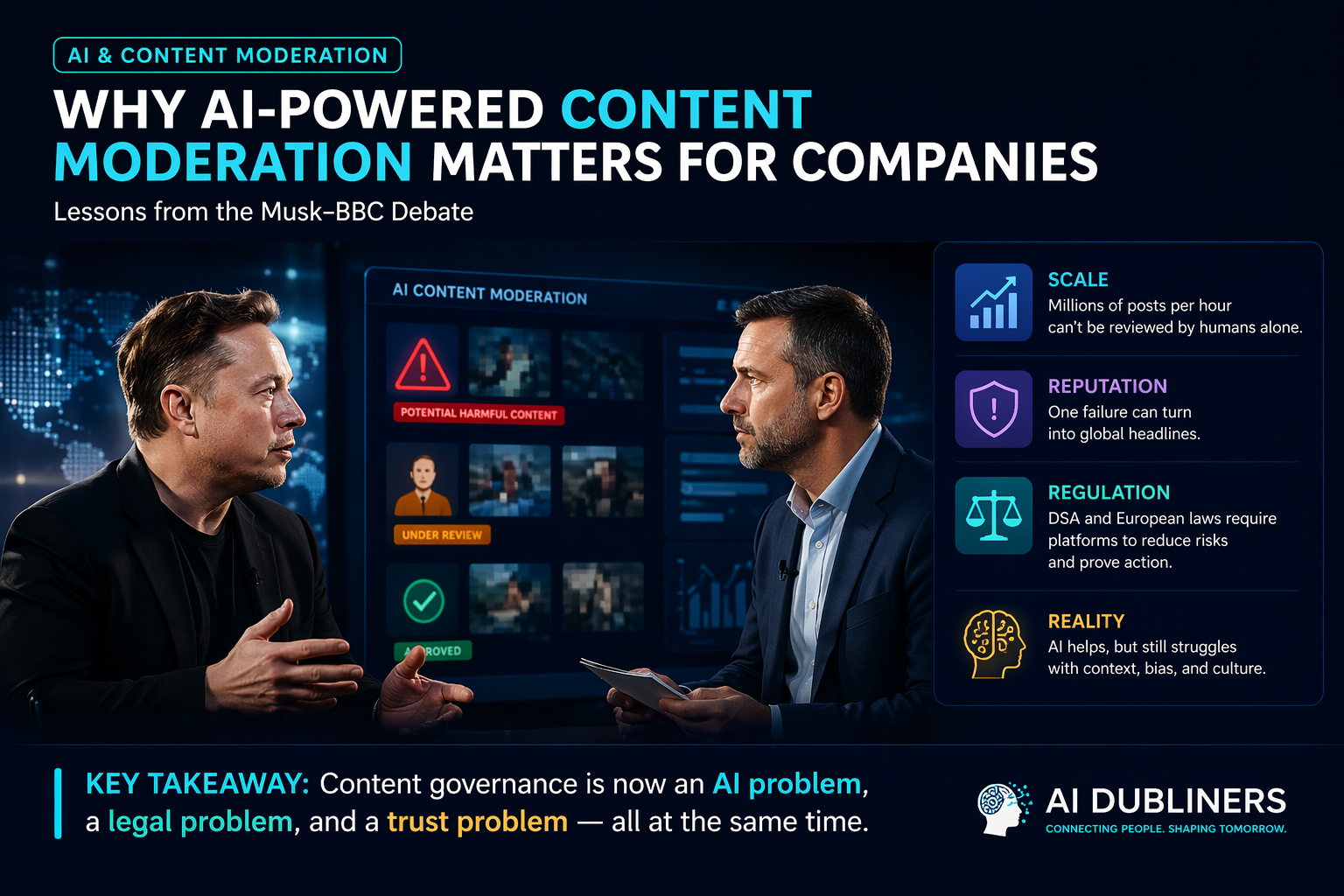
For platforms and digital services today, moderation is no longer just an operational challenge. It has become a business risk, a legal responsibility and a reputational issue all at once.
The scale problem
The volume of online content has made human-only moderation increasingly difficult to sustain.
Text, images, video and live streams are generated at a scale that no manual process can fully manage on its own. That is why AI is now being used across moderation systems to help:
- pre-filter harmful content
- prioritise high-risk cases
- respond faster in real time
- support large-scale review workflows
This is no longer optional infrastructure. For many platforms, it is becoming a core part of operational resilience.
Why the risk is no longer only technical
A moderation failure is rarely contained.
What begins as a platform issue can quickly become a public, legal and reputational problem. Harmful or illegal content can escalate into headlines, user backlash and regulatory scrutiny within minutes.
That changes the role moderation plays inside a business.
It is no longer only about community safety. It also affects trust, brand credibility and institutional accountability.
Europe is changing the standard
In Europe, the regulatory environment is making this even more significant.
The Digital Services Act has introduced a stronger framework for how platforms handle illegal content, user protection and transparency around moderation decisions. In practice, that means it is no longer enough for companies to say they moderate content. They increasingly need to show how those systems work, what processes support them and how users are protected.
This raises the standard for digital platforms operating in Europe.
Why AI alone is still not enough
AI now plays an essential role in moderation, but its limits remain clear.
It can still struggle with:
- context
- cultural nuance
- sarcasm
- ambiguity
- intent
That is why the most effective moderation systems today are still hybrid. They combine AI with human oversight, clear escalation paths and well-defined policies.
The question is not whether AI should be involved. It is how it should be governed.
Beyond social media
These challenges do not apply only to large social platforms.
Marketplaces, gaming environments, education products, health platforms and community-driven services all face similar pressures as user-generated content and digital interaction scale.
That is why content governance is becoming more important across the wider digital economy.
A wider signal
At AI Dubliners, we focus not only on how AI is built, but on how it is applied in the real world and what kinds of consequences it creates.
Content moderation is a strong example of that shift. It is no longer just a technical problem. It now sits at the intersection of AI, law, trust and business risk.
And across Europe, understanding that shift is becoming increasingly important.


