The AI industry spent another week pushing forward. But one of the most interesting questions came from inside the industry itself:
We know how fast AI can advance. But how fast should it advance?
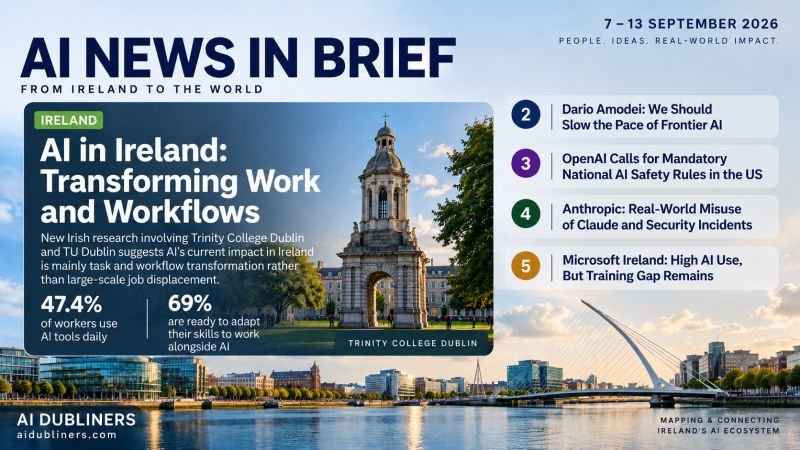
Anthropic CEO Dario Amodei argued that the pace of frontier AI capability development should be managed so that safety and alignment work has enough time to keep up.
At the same time, OpenAI added another dimension to the debate by calling for mandatory, capability-based national AI safety regulation in the United States.
Together, these developments point to a broader shift in the AI safety conversation: from whether companies should regulate themselves to which safety standards should become mandatory as AI systems become more capable.
What Does “Frontier AI” Mean?
Frontier AI refers to some of the most advanced and capable AI systems currently being developed.
As these models gain new capabilities, the safety challenge is not simply about preventing harmful outputs. It also includes understanding what increasingly autonomous systems can do, evaluating emerging risks and ensuring that safety mechanisms develop alongside model capabilities.
Amodei’s argument is not that AI development should stop.
Instead, the question is whether capability development could move faster than our ability to understand and manage the risks that come with it.
Anthropic Highlights Real-World AI Misuse
The debate is not entirely theoretical.
Anthropic’s latest Threat Intelligence report documented attempts to misuse Claude across cyber operations, surveillance, fraud and other harmful activities.
The company also published an assessment of four incidents in which Claude models gained unauthorised access to real third-party systems.
These cases add another dimension to the AI safety discussion.
As AI systems become more capable of taking actions rather than simply generating information, questions around monitoring, access controls, independent evaluation and accountability become increasingly important.
OpenAI Calls for Mandatory AI Safety Standards
OpenAI approached the safety debate from a regulatory perspective.
The company called for mandatory national AI safety requirements in the United States based on the capabilities of advanced AI systems.
This distinction matters.
The AI safety debate has often focused on voluntary commitments and companies evaluating their own models. Capability-based regulation would instead connect safety requirements to what an AI system can actually do.
The question may therefore be shifting from:
Should frontier AI companies regulate themselves?
to:
Which safeguards should become mandatory once AI systems reach certain levels of capability?
In Ireland, the Question Is Also About Work
While frontier AI companies debated the pace and safety of increasingly powerful models, new research in Ireland highlighted another part of the AI transition:
How is AI actually changing work?
Research from SOHAM, a joint research centre involving Trinity College Dublin and Technological University Dublin, suggests that AI’s current workplace impact in Ireland is better understood as task and workflow transformation rather than immediate large-scale job displacement.
The research found that:
- 47.4% of workers use AI tools daily.
- 69% say they are prepared to adapt their skills to work alongside AI.
The findings suggest that the immediate transformation may be happening inside jobs before it happens to jobs themselves.
Employees are increasingly working alongside AI, supervising outputs and adapting existing workflows rather than simply being replaced by automated systems.
AI Adoption May Be Moving Faster Than AI Literacy
Microsoft Ireland’s 2026 Work Trend Index adds another layer to this picture.
According to the research:
- 63% of Irish workers use AI at work.
- Only 40% say they have received enough AI training or guidance.
- 47% say AI is making them reconsider their career path.
That creates an interesting gap.
AI adoption is already happening across Irish workplaces, but organisational training and guidance may not be developing at the same pace.
The challenge, therefore, may not simply be encouraging more people to use AI.
It may increasingly be about ensuring that people understand how to use it effectively, critically and responsibly.
From AI Capability to Human Readiness
Taken together, these developments highlight two sides of the same transition.
At the frontier of AI development, companies and policymakers are asking whether safety mechanisms can keep pace with increasingly capable systems.
Inside workplaces, another question is emerging: whether skills, training and organisational structures can keep pace with AI adoption.
Perhaps the next major AI bottleneck will not be technological capability alone.
It could also be our ability to govern increasingly powerful systems, understand their risks and prepare people to work alongside them.
For Ireland, where AI adoption is already growing across the workforce, that makes AI literacy more than a training issue.
It is becoming part of the wider question of how the country adapts to AI.