As a new week begins, I wanted to look back at some of the AI developments in September 2026 that caught my attention between 21 and 27 September.
Keeping up with every new model, investment, infrastructure plan and policy development is becoming increasingly difficult. So, as I read and research throughout the week, I bring together a few stories that stood out to me and that you may have missed too.
OpenAI Expands the GPT-6 Family With Sol and Luna
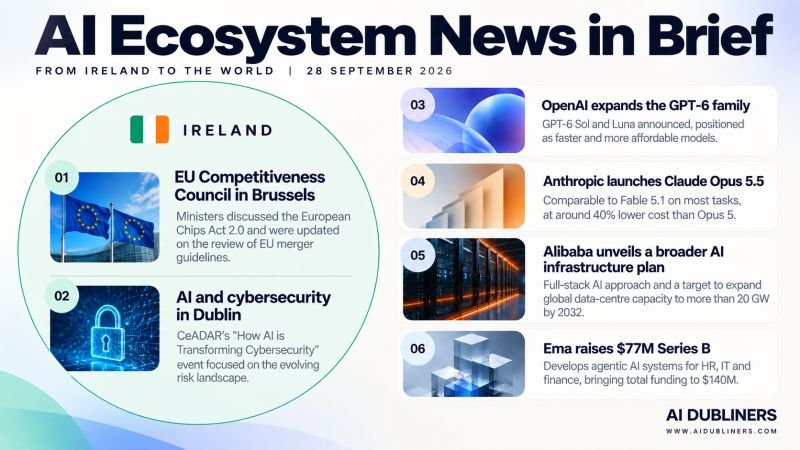
Following the launch of GPT-6 Astra, OpenAI announced GPT-6 Sol and GPT-6 Luna on 22 September.
OpenAI positions the two models as faster and more affordable options that bring many of Astra’s advances to a broader range of use cases. API prices for GPT-6 Sol and Luna were announced at 50% below the promotional pricing of their GPT-5.6 predecessors.
What stands out to me is not only that these models are becoming more capable. Cost is also becoming a more important part of model comparisons. No matter how capable a model is, the cost of running it can significantly affect how widely it can be used.
Anthropic Introduces Claude Opus 5.5
On the same day, Anthropic released Claude Opus 5.5.
Anthropic says the new model performs at a level comparable to Claude Fable 5.1 across many tasks. According to the company, Opus 5.5 costs around 40% less to run than Opus 5 on typical workloads and generates output more than 30% faster.
The fact that both OpenAI and Anthropic focused on cost and efficiency as well as performance is worth noting. Model competition is no longer only about which system achieves the highest benchmark score. The resources required to complete the same work are becoming an increasingly visible part of the comparison.
Alibaba Outlines a Broader AI Infrastructure Plan
At its 2026 Apsara Conference, Alibaba presented a full stack AI strategy covering chips, cloud infrastructure, models and AI agents.
The company also announced a target for the global data centre capacity operated by Alibaba Cloud to exceed 20 GW by 2032.
Another detail that caught my attention personally was Alibaba Cloud’s plan to establish its first cloud regions in Türkiye, Finland and the Netherlands over the next 12 months. The announcement shows that Alibaba’s AI ambitions extend beyond models to the physical and cloud infrastructure needed to support them.
Ema Raises $77 Million
One of the enterprise AI developments that caught my attention was Ema’s $77 million Series B funding round.
The company develops agentic AI systems that operate across business areas including HR, IT and finance. Ema describes these systems as “AI Employees.”
The new round brings the company’s total funding to $140 million. Ema also says its customers are using these systems in real operations, handling millions of interactions each year rather than limiting them to experimental projects.
What makes this development interesting to me is not only the size of the investment. Understanding how companies are beginning to use agentic AI across daily business processes may tell us more about the direction of enterprise AI.
AI Enters Europe’s Competition Policy Discussions
One of the week’s Ireland related developments took place in Brussels on 24 September.
During Ireland’s Presidency of the Council of the European Union, the Competitiveness Council discussed the proposed European Chips Act 2.0 and the ongoing review of the EU Merger Guidelines.
The review aims to ensure that Europe’s competition framework reflects developments including digitalisation, artificial intelligence and business models driven by data.
Here, AI is not appearing as a separate technology story. It is becoming an economic factor that may influence how company mergers and competition conditions are assessed across Europe.
CeADAR Brings AI and Cybersecurity Together in Dublin
On the same day, CeADAR organised its “How AI is Transforming Cybersecurity” Business Beacon event at the Clayton Hotel in Ballsbridge.
The event focused on the intersection of AI and cybersecurity. Its programme covered the evolving cyber risk landscape, privacy, AI governance and cybersecurity services available through the European Digital Innovation Hub programme.
It was another recent example of how both the opportunities and risks created by AI are becoming part of wider business and research discussions in Ireland.
From Models and Infrastructure to Business and Policy
These developments do not tell a single story. However, when viewed together, they show more clearly that the AI conversation is no longer limited to new model launches.
More capable and affordable models are being released. Companies are investing in data centres. AI agents are entering real business processes. Competition policies are being reviewed, and cybersecurity risks are receiving greater attention.
These are some of the developments that stood out to me while reading and researching last week.
What would you add to the list? Did I miss an AI development that caught your attention?