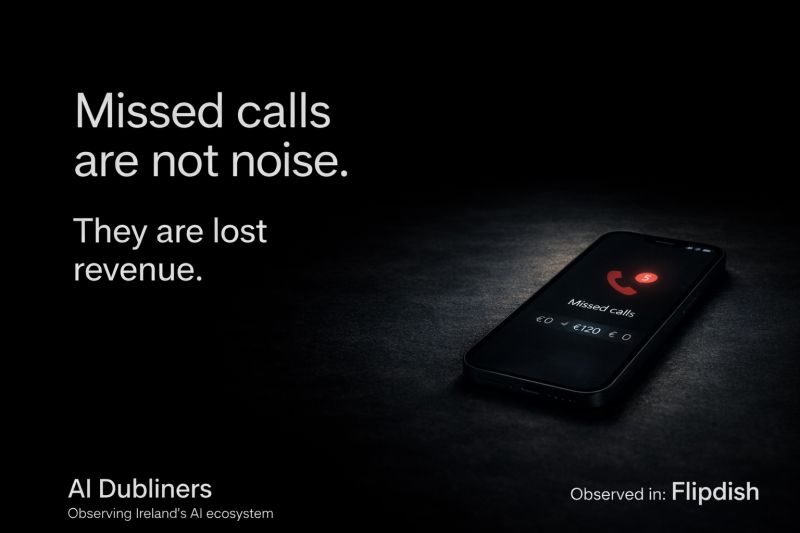
Restaurants do not always lose customers because of food quality. Often, they lose them because no one answers the phone.
That is what makes Flipdish worth watching.
At AI Dubliners, we spend a lot of time thinking about what makes a company truly AI-native, AI-powered, or simply AI-enabled. As AI becomes part of almost every tech conversation, those labels matter less than the way AI is actually used in day-to-day operations.
That is where the more meaningful shift is happening.
Sometimes AI is not about replacing people. It is about fixing the points of friction businesses have lived with for years: missed calls, lost orders, overloaded staff, and the chaos of peak hours.
This is where Dublin-founded Flipdish stands out.
Flipdish is not an AI company in the traditional sense. It is a hospitality platform. But inside that platform, AI is quietly becoming part of the operating layer.
Its AI Phone Agent is designed to answer calls instantly, take orders, process payments, recommend upsells, and send confirmed orders directly into the restaurant’s existing system. The point is not the novelty of talking to AI. The point is fewer missed opportunities during the busiest parts of the day.
That is what makes this interesting.
This is not AI as a demo. It is AI embedded into workflow.
No big promises. No unnecessary complexity. Just a practical use case where AI is being applied to a part of the business that directly affects revenue, service, and staff workload.
And that raises a bigger question for the years ahead.
If AI is increasingly able to handle customer-facing interactions such as calls, orders, and transactional steps, then the conversation is no longer only about automation. It is also about how we define staffing, operations, and human roles in service businesses going forward.
At AI Dubliners, this is the shift we are watching closely.
Not just what companies say about AI, but how they are embedding it into real workflows. Because that is where real transformation begins.
So the question is not whether this is technically possible. It already is.
The real question is whether this should be seen as augmentation, or the beginning of something closer to replacement.