At first glance, this might seem slightly outside the usual AI Dubliners lens.
But it is actually a very relevant question.
As AI becomes more present in creative industries, the conversation is no longer only about what these tools can generate. It is also about how institutions, industries, and audiences will evaluate work made with them.
And that brings us to the Oscars.
The Academy’s current position is clear. Under the rules approved for the 98th Academy Awards in April 2025, the use of generative AI or other digital tools does not automatically help or harm a film’s chances of being nominated. What still matters is the degree to which human creative authorship sits at the center of the work.
That is an important distinction.
It means a film can use AI and still be eligible for Oscar recognition. But the Academy is not, at least for now, treating AI itself as the creative author. The award remains tied to human achievement.
This is why the more interesting question is not whether AI can appear in filmmaking. It already does.
AI tools are increasingly being used across scripting support, visual experimentation, voice and sound workflows, editing assistance, and production planning. What is still evolving is where the industry draws the line between AI-assisted filmmaking and truly AI-generated cinema.
That line may not stay fixed for long.
As AI-driven production tools become more capable, it is entirely plausible that within the next few years we will see stronger debate around films whose creative process is deeply shaped by AI systems. Whether those films are described as AI-assisted, AI-directed, or fully AI-generated, the pressure on award institutions will only grow.
There is also another angle to this shift.
Films about AI are gaining more cultural visibility too. One recent example is The AI Doc: Or How I Became an Apocaloptimist, which premiered at Sundance on January 27, 2026 and was released by Focus Features on March 27, 2026. That does not mean it is headed for the Oscars, but it does show how central AI has become as a cinematic subject in its own right.
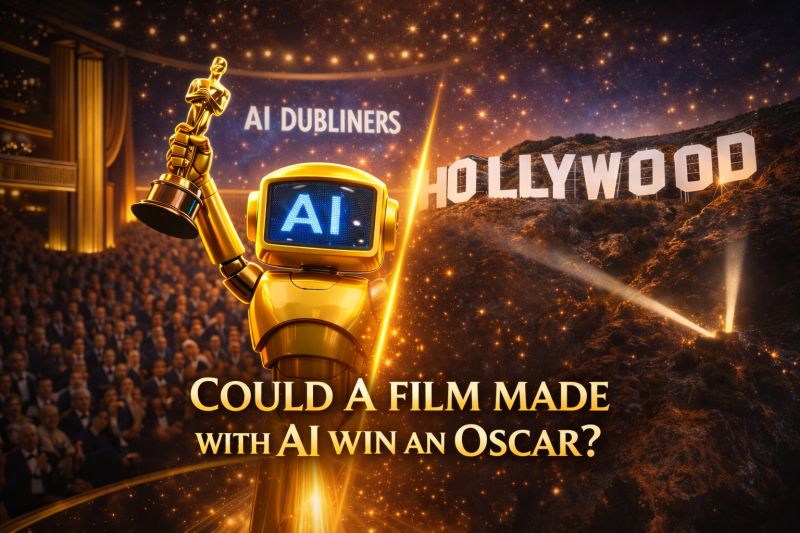
So could a film made with AI win an Oscar?
Under the Academy’s current rules, yes, if AI is used as part of the process and the work is still judged to reflect meaningful human creative authorship.
A more provocative question is what happens when that balance shifts.
If AI becomes central not only to the tools of production but to the creative logic of the film itself, then the Oscars, and the wider film industry, may eventually need to redefine what authorship means.
That is where the real debate is heading.
For context, the 98th Oscars were held on March 15, 2026, and the 99th Oscars are scheduled for March 14, 2027. If AI continues advancing at its current pace, this conversation may feel much less theoretical by then.