Ireland has taken a significant step forward in its national artificial intelligence agenda. Minister of State for Trade Promotion and Artificial Intelligence Niamh Smyth has welcomed the publication of the NESC Ireland report, titled “Artificial Intelligence in Service of Society: Navigating our Way Forward.”
The report reframes the AI conversation. It moves beyond capability to ask what AI should do, for whom, and under what conditions. This values-first approach aligns closely with Ireland’s broader ambition to become a responsible and competitive AI nation.
It also lands at exactly the right moment. The NESC report does not stand alone. It accompanies a much wider national plan that is now visibly moving from paper into practice.
Complementing Ireland’s National Digital and AI Strategy
The NESC report accompanies Ireland’s newly published National Digital and AI Strategy, which sets out the country’s vision to 2030 across 90 deliverables. Four pillars are identified as the foundations on which everything else depends: skills, governance, infrastructure, and public trust.
The pairing is deliberate. The NESC report supplies the values framework. The National Digital and AI Strategy supplies the operational roadmap. Together they answer two distinct questions: what kind of AI nation does Ireland want to be, and how will it actually get there.
Five initiatives now underway
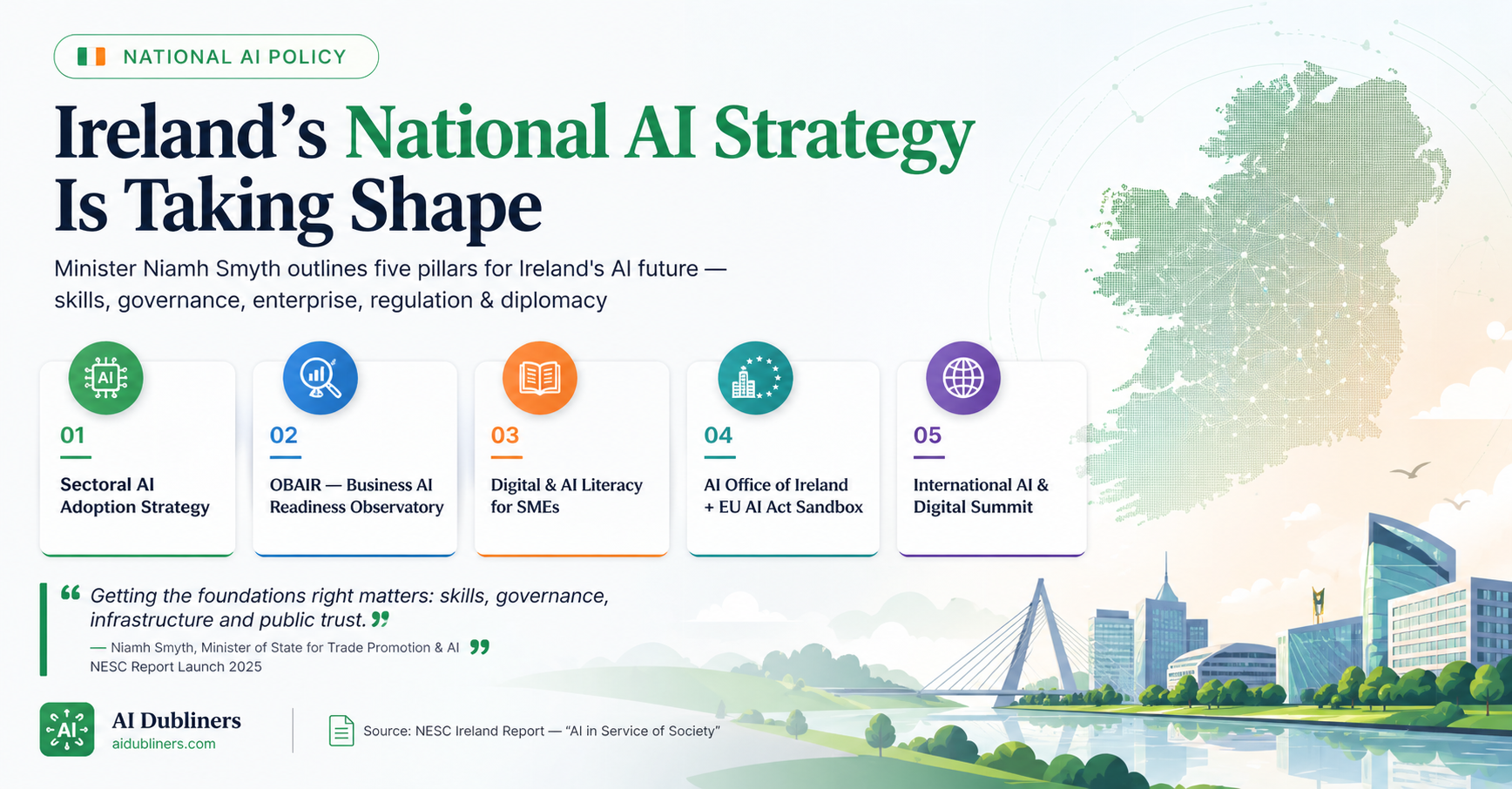
The Department of Enterprise, Tourism and Employment has confirmed active progress on five concrete initiatives. Each one targets a specific gap in how AI is currently adopted, governed, and understood in Ireland.
Sectoral AI Adoption Strategy
A targeted plan to drive AI uptake across the Irish enterprise base, supported by AI Sector Champions who will spotlight opportunities industry by industry. The aim is to move adoption from broad encouragement into specific sectoral roadmaps that businesses can act on.
OBAIR — Observatory for Business AI Readiness
A new national intelligence platform designed to track and measure how Irish enterprises are actually engaging with AI. OBAIR addresses one of the persistent weaknesses in AI policy globally: the absence of reliable data on real-world adoption. Without measurement, strategy becomes guesswork.
Digital and AI Literacy Campaign for SMEs
A dedicated programme to build AI capability among small and medium enterprises across Ireland. SMEs form the backbone of the Irish economy, yet they are often the slowest to adopt new technology — not because of unwillingness, but because of a lack of structured support. This campaign is designed to close that gap.
AI Office of Ireland
A new central coordinating authority for the EU AI Act, launched alongside an AI Regulatory Sandbox. The Office will give Ireland a single, accountable body for AI compliance and oversight, while the sandbox will let companies test AI systems in a structured regulatory environment before full deployment.
International AI and Digital Summit
A flagship event to be hosted during Ireland’s Presidency of the Council of the EU. The summit will position Ireland not just as a participant in European AI policy, but as a host and convenor of it.
A deliberate and structured approach
These five initiatives reflect something more than a checklist of activity. They reflect a deliberate, structured approach, one that positions Ireland not just as a host for global tech companies, but as an active shaper of how AI is governed and adopted at scale.
The combination matters. A values framework without operational follow-through becomes rhetoric. Operational delivery without a values framework becomes drift. Ireland’s AI Strategy is now attempting to do both at once.
The AI Dubliners view
At AI Dubliners, we follow how AI moves from announcement into adoption. What stands out about Ireland’s current direction is that the policy layer and the practical layer are starting to align. The NESC report gives the country a public language for talking about AI responsibly. The National Digital and AI Strategy gives it the institutional machinery to make those values operational.
For Irish businesses, the practical implication is straightforward. The next two years will not be about whether to engage with AI, but about how to do it in a way that aligns with national direction, sector-specific guidance, and an emerging regulatory framework.
For the wider Dublin AI community, this is a moment to pay attention. National strategies of this scale rarely come together this coherently. When they do, the organisations that engage early tend to shape what comes next.
Source: LinkedIn post by Niamh Smyth, Minister of State for Trade Promotion and Artificial Intelligence