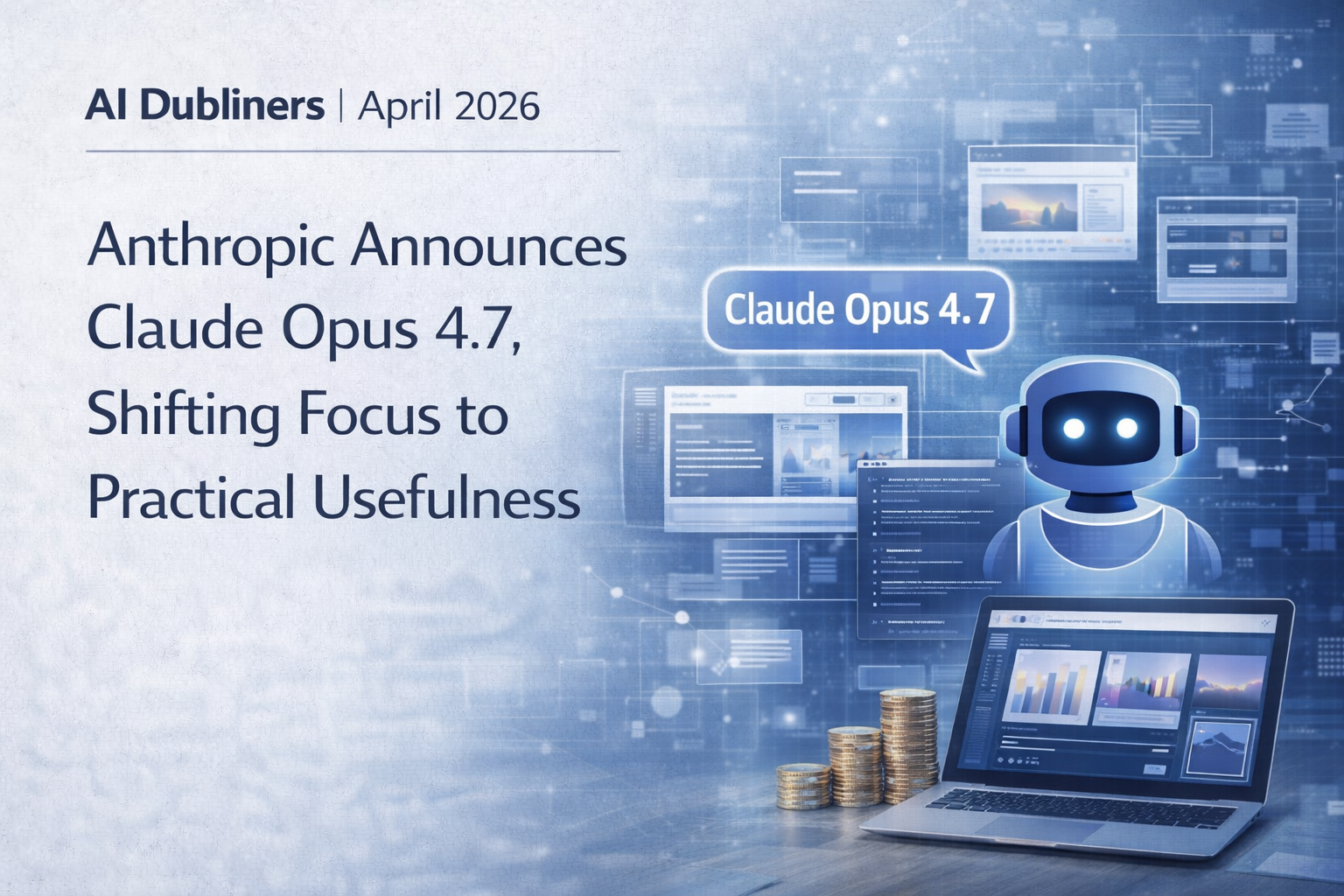
Anthropic has introduced Claude Opus 4.7, its latest flagship model, and the announcement points to something larger than a standard model update.
The real signal is not only improved intelligence. It is improved usefulness.
According to Anthropic, Claude Opus 4.7 delivers stronger performance in advanced software engineering, better vision capabilities and more consistent results on long-running, multi-step tasks. The company also says the model produces higher-quality interfaces, slides and documents in professional workflows.
More than a model upgrade
At first glance, Claude Opus 4.7 may look like another step in the rapid model race.
But what stands out is where the improvements are being applied.
Anthropic is positioning the model not only as a better reasoning system, but as a more practical one, especially for coding, agentic workflows and professional output. That includes tasks where structure, consistency and execution matter more than raw novelty.
In that sense, the update reflects a broader trend across the AI market: the conversation is moving away from what models can demonstrate in isolation, and toward how well they perform in real working environments.
Can it build websites and presentations?
This is where the wording matters.
Anthropic’s official announcement does not frame Claude Opus 4.7 as a dedicated website builder or presentation platform. However, it does explicitly say the model is more creative and capable in professional tasks, producing better-quality interfaces, slides and documents.
That means the stronger claim is not that it “is” a website or presentation tool on its own, but that it is increasingly capable of supporting and generating work in those formats.
That is still a meaningful shift.
Why this matters
The value of models like Claude Opus 4.7 is becoming easier to understand in practical terms.
Instead of being used only for chat or ideation, they are now being positioned for:
- advanced coding
- multi-step agent workflows
- interface generation
- slide and document creation
- longer-running professional tasks
This matters because it shows how AI is moving deeper into production workflows, not just lightweight assistance.
What this means for Dublin
For Dublin’s AI and startup ecosystem, updates like this matter because they lower the barrier between experimentation and execution.
As frontier models become more reliable across coding, product design and content workflows, companies in Dublin are better positioned to use them in internal systems, client work and digital product development. That can accelerate not only output, but also the speed at which teams test and build new ideas.
A wider signal
At AI Dubliners, we pay attention to announcements like this not only because of the model itself, but because of what it signals.
Claude Opus 4.7 is another sign that AI models are being judged less by novelty and more by how effectively they support real work.
And that is where the next phase of adoption is likely to happen.