When a customer asks ChatGPT, Gemini, Claude or Perplexity about your brand, what kind of answer do they receive? Does AI place your company in the right category and use up-to-date information, or does it present your competitors as stronger alternatives?
This is no longer just a theoretical marketing question. ChatGPT and Google’s AI Mode are directly helping users discover products, compare options and make decisions. Brand visibility can therefore no longer be measured only by where a company ranks in search results.
Kojable, a startup growing in Dublin, aims to help brands understand how they are represented by AI systems and improve that representation.
What Does Kojable Do?
Founded by Piush Vaish, Kojable describes itself as an “AI answer alignment platform”. In other words, it focuses on bringing AI-generated answers into closer alignment with a brand’s actual position.
Kojable does not simply check whether a brand appears in AI-generated answers. It examines how systems such as ChatGPT, Claude, Gemini and Perplexity describe the brand, which competitors they compare it with and what important information they leave out.
The company outlines a four-step process:
- Monitoring how a brand is currently represented across different AI systems
- Identifying outdated sources, missing evidence and positioning issues that may influence AI-generated answers
- Showing which content or sources should be improved
- Retesting similar questions to measure whether the brand’s representation has changed
This approach aims to go beyond providing a simple visibility score. The goal is to understand why a brand is being described in a particular way and create a practical plan for improvement.
How Is This Different From Traditional SEO?
Traditional SEO focuses on helping a web page appear in search results and rank more prominently. In AI-powered search experiences, however, the system may combine information from several sources to generate a direct answer.
This emerging field is often described as “AI SEO”. The term “Generative Engine Optimization”, or GEO, has also been used in academic research to explain how content can gain visibility within generative AI responses. One of the first comprehensive frameworks for the concept appeared in a GEO research paper published in 2023.
However, AI SEO should not be viewed as a separate system that completely replaces traditional SEO. Clear and up-to-date web pages, verifiable company information and trustworthy independent sources remain essential.
What is changing is how success is measured. Ranking still matters, but so does the way a brand is represented within AI-generated answers.
An AI Visibility Startup Growing From Dublin
Kojable’s connection to Dublin goes beyond its location. In 2025, Piush Vaish was among the entrepreneurs who completed the Enterprise Ireland New Frontiers Phase 2 programme at TU Dublin Tallaght.
The programme described Kojable as a startup helping small and medium-sized businesses become easier to find through AI-powered search. This experience places Kojable among Dublin’s early-stage ventures working to bring a technical idea to market.
The AI Dubliners Perspective
What stands out to us in Kojable’s story is how visibility is expanding from ranking to representation.
Simply appearing in an AI-generated answer may not be enough. The category in which a brand is placed, the competitors it is compared with and any outdated information repeated about it can all influence customer perception.
AI-generated answers can vary depending on the model, the question, the available sources and the time of the search. For this reason, AI visibility is unlikely to be something a company can optimise once and then forget about. Kojable’s approach of monitoring, diagnosing, improving and retesting therefore makes sense.
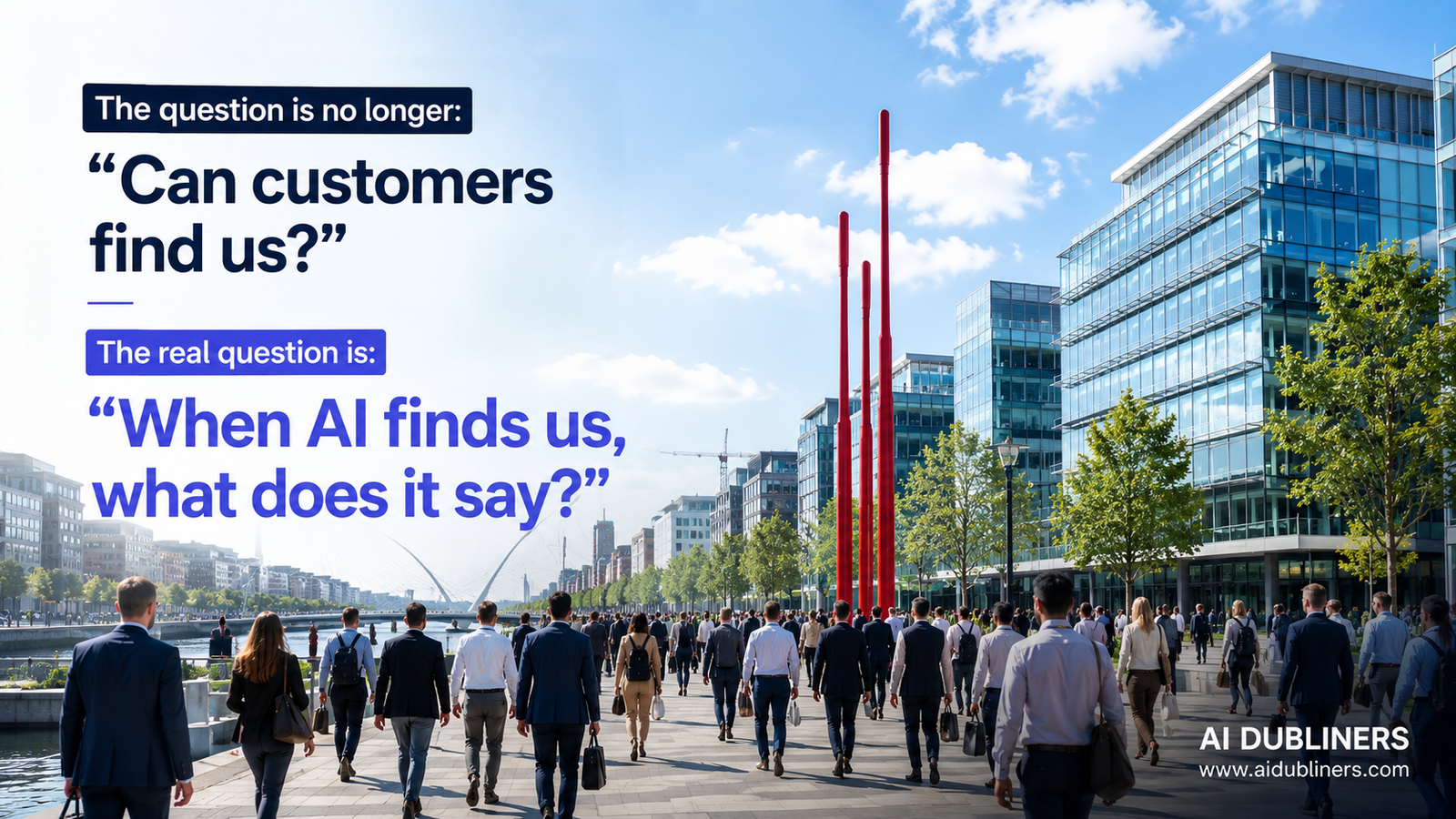
For brands, the question is no longer only, “Can customers find us?”
The more important question is: “When AI finds us, what does it say about us?”
Searces:
Kojable
OpenAI: Powering Product Discovery in ChatGPT