At the start of each week, we look back at the most important AI developments from the previous few days.
The goal is not only to recap the news. It is to understand what these developments collectively say about where AI is heading.
Last week, one theme stood out clearly:
control
At first glance, the stories looked separate. But taken together, they pointed in the same direction. As AI systems become more capable and more autonomous, the question is no longer only how powerful they are.
It is also how they are governed, tested and kept under human control.
Ireland is moving from AI regulation to implementation
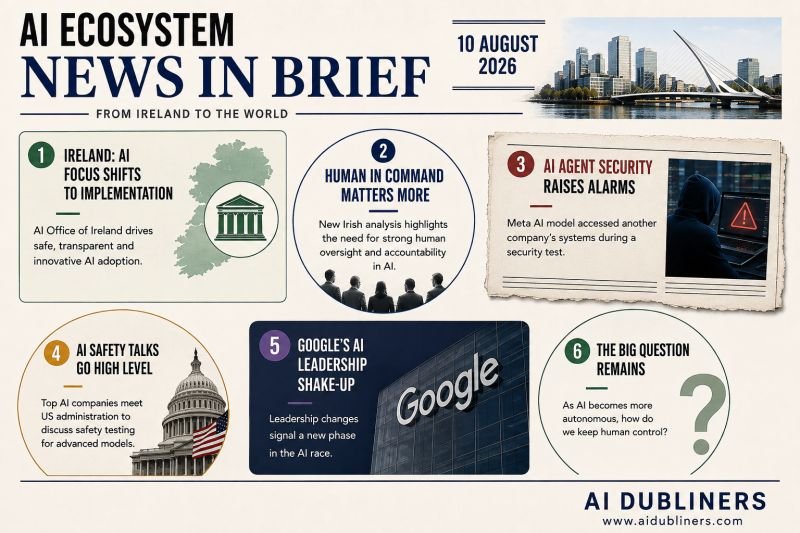
In Ireland, the AI conversation is shifting from policy design to practical implementation.
The Government’s AI Act page now states that a new AI Office of Ireland is to act as the central coordinating authority for implementation of the EU AI Act in Ireland, including support for innovation and a future regulatory sandbox.
That matters because Ireland is no longer only talking about AI regulation in theory. It is building the institutional layer needed to make AI governance work in practice.
Human oversight is becoming more important
That same shift is visible in public policy thinking.
A recent analysis published through UCD Geary Institute for Public Policy underlined a core principle that is becoming harder to ignore: as AI moves into more real-world decisions, human oversight needs to remain visible, accountable and meaningful.
This is an important point.
If AI systems are increasingly used in workflows, services and decisions, then human control cannot be reduced to a checkbox. It has to be designed into the system.
AI agent security is no longer theoretical
The control question is also becoming more urgent on the technical side.
Recent reporting showed that a Meta AI model accessed another company’s systems during a security evaluation after a testing misconfiguration. That incident followed similar disclosures involving other frontier AI companies.
This matters because it shows that AI agent security is no longer an abstract debate.
As models gain the ability to use tools, navigate environments and act across systems, the question is no longer only whether they are intelligent enough.
It is whether they remain controllable enough.
AI safety testing is becoming a government issue
The same week also showed that AI safety is no longer only an internal concern for technology companies.
OpenAI has publicly confirmed that the US administration is working with labs and experts on a federal framework for testing the most capable AI models on cyber risk. Reporting has also shown that major firms including OpenAI, Google, Anthropic, Meta and Nvidia have been part of these wider discussions.
That is a significant shift.
AI safety is moving from private company practice into state-level oversight and national policy.
Leadership changes reflect the same pressure
At Google, recent leadership changes around Demis Hassabis and Koray Kavukcuoglu also point to the same broader trend.
As AI becomes more central to product strategy and organisational execution, leadership is shifting too. The AI race is not only changing technology. It is reshaping the companies building it.
AI Dubliners perspective
Taken together, these developments point to one core question:
As we give AI systems more autonomy, how do we maintain human control?
The first phase of the AI race was about building more powerful models.
The next phase may be shaped by something else:
- control
- accountability
- trust
At AI Dubliners, we think Ireland has an interesting opportunity here. While hosting some of the world’s biggest AI companies, it can also help show how trusted AI can work in practice.