This week began with a Bank Holiday in Ireland. But our weekly ritual remains unchanged.
At the beginning of each week, we look back at the most important AI developments from the previous week. We do this not simply to recap the news, but to understand the broader direction in which AI is moving.
Last week’s headlines may have appeared unrelated at first.
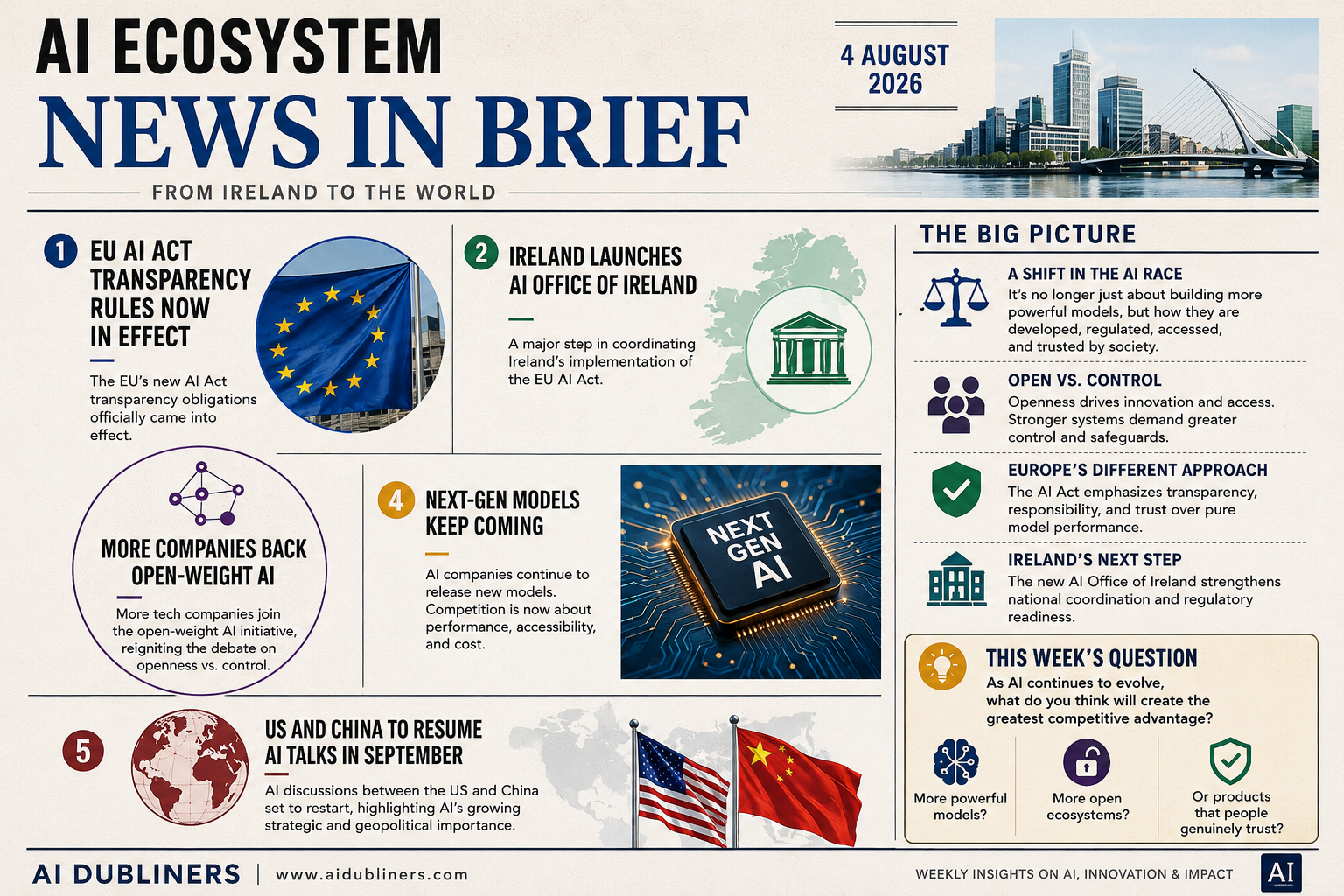
New transparency obligations began to apply across the European Union. Ireland formally established the AI Office of Ireland. The number of companies supporting open-weight models continued to grow. Meanwhile, the United States and China were reported to be preparing for AI discussions in September.
However, when considered together, these developments point to the same transformation.
The AI race is no longer only about building more powerful models. How those models are developed, who can access them, which rules they must follow, and whether society considers them trustworthy are also becoming part of the competition.
The Measures of the AI Race Are Changing
During the earlier stages of the AI industry, progress was largely measured by model capability.
More parameters, higher benchmark scores, longer context windows, and faster responses helped companies stand out.
These measures still matter. But they are no longer enough on their own.
Alongside the power of a model, businesses are increasingly considering how easily it can be implemented, how much it costs to operate, how data is protected, and whether its outputs can be understood and explained.
In other words, AI competition is expanding beyond technical performance towards the quality of real-world implementation.
In Europe, Transparency Is Becoming a Design Requirement
The transparency obligations under Article 50 of the European Union’s AI Act began to apply on 2 August 2026.
Under the new rules, certain chatbots and interactive AI systems must inform users that they are communicating with an AI system rather than a human.
The framework also includes requirements related to labelling deepfake content and adding machine-readable markings to certain content generated or modified by AI.
This change is about more than adding new warning messages.
Transparency is becoming something that must be considered from the beginning of the design process, rather than being added later as a compliance feature. This could directly affect how AI companies approach product development, user experience, and content management.
Europe’s direction is becoming clearer. The objective is not only to develop more advanced AI systems, but also to create an environment in which those systems can be understood and questioned by society.
Ireland’s Role Is Shifting Towards Coordination
One of the most important developments for Ireland was the formal establishment of the AI Office of Ireland.
On 30 July, Ireland’s Department of Enterprise, Tourism and Employment announced the establishment of the AI Office of Ireland and the appointment of Paul Byrne as its first CEO.
Created as an independent public body, the office will provide central coordination for the implementation of the EU AI Act in Ireland. It will also act as a single point of contact for the European Commission, national regulators, and the public.
Its responsibilities are not limited to regulatory oversight. Supporting a consistent approach among regulators, improving access to technical expertise, and encouraging the responsible use of AI in Ireland are also part of its role.
This is particularly important for Ireland.
The country hosts major operations belonging to some of the world’s leading technology companies and foundation model providers. As a result, many practical questions about how Europe’s AI rules will be implemented may need to be addressed here.
The real challenge will be finding a way for innovation and oversight to move forward together without unnecessarily slowing each other down.
Why Are Open-Weight Models Back in the Debate?
During the same period, the number of companies supporting open-weight AI models also grew rapidly.
As of 3 August, more than 270 companies and organisations had supported Microsoft’s open letter, “Open Weights and American AI Leadership”. Its supporters include major industry players such as Microsoft, Meta, Nvidia, Amazon, Google, and OpenAI.
It is important to maintain the distinction between “open weight” and “open source.”
Open-weight models may allow developers to download, adapt, or run trained model weights on different infrastructures. However, this does not necessarily mean that the training data or the entire development process is publicly available. The Open Source Initiative also emphasises that these two concepts are not the same.
Supporters argue that open-weight models can accelerate innovation, make advanced AI systems more accessible to smaller companies, and reduce dependence on a single provider.
On the other hand, there are concerns about increasingly capable models being modified and distributed without sufficient safeguards.
The debate is therefore not simply about choosing between open and closed models. The more important question is how responsibility can be maintained as access expands.
AI Is Now a Geopolitical Issue
AI competition is not shaped only by companies and regulators. Governments are also becoming increasingly visible participants in this race.
Reuters reported that the United States and China were preparing to hold formal discussions on AI in September. However, the date, agenda, and participants have not yet been officially confirmed.
According to the report, the discussions could cover the potential effects of advanced AI models on military use, cybersecurity, and employment. The planned meeting could become the first formal US-China AI dialogue under the current US administration.
This development shows that AI is no longer simply a technology product.
Access to AI models, semiconductor supply, intellectual property, security standards, and the international distribution of models are all becoming part of global relations.
A New Balance Between Power, Openness and Trust
Last week’s developments represent different parts of the same question.
Europe is applying new rules focused on transparency and responsibility.
Ireland is establishing the institutional structure needed to coordinate those rules at the national level.
Technology companies are calling for greater room to develop and distribute open-weight models.
The United States and China are increasingly treating AI as a strategic and geopolitical issue.
None of these developments will determine the future of AI on its own.
Building more powerful models will remain important. Open ecosystems may create new opportunities for researchers and smaller companies. Regulation alone, however, will not be enough to create trust.
The greatest competitive advantage may belong to the companies and countries that can bring these elements together through useful products and trustworthy applications.
Perhaps the first era of AI was about building increasingly powerful models.
The next may be defined by how that power is applied, governed, and trusted by society.
As AI continues to evolve, what do you think will create the greatest competitive advantage?
More powerful models?
More open ecosystems?
Or products that people genuinely trust?
Searches:
European Commission: Transparency obligations under the AI Act
EU AI Act implementation timeline
Publication of the Regulation of Artificial Intelligence Bill 2026