Workplace AI training is becoming increasingly common. Some companies provide it through their own teams, while others bring in external support.
This is a positive development. But it raises another question for me:
Are employees learning how to work with AI, or only how to use the AI tool their company has chosen?
Why does product training matter?
If a company uses Microsoft Copilot, employees need to understand its features, integrations and safe-use rules. The same applies to ChatGPT, Claude or Gemini.
According to a Microsoft case study about PwC Canada, Microsoft 365 Copilot was introduced across an organisation of around 8,000 people alongside an upskilling programme for all employees. The aim was to help them use Copilot effectively in their daily work.
This kind of product training is necessary. But is it enough?
What is AI literacy?
AI literacy is broader than knowing how to use one product. It is the ability to use AI systems effectively, critically, safely and responsibly.
It includes:
- Defining the problem clearly
- Providing AI with enough context
- Giving clear instructions
- Questioning and validating outputs
- Understanding AI’s limitations and data risks
- Knowing which decisions should remain with people
These skills do not belong only to Copilot, ChatGPT or any other product. They can remain with employees when the tool changes.
Why are AI skills becoming more important in Ireland?
The conversation in Ireland is also moving beyond tool usage.
Ireland’s AI in Enterprise study, launched in July 2026, is examining the skills, talent and organisational capabilities businesses need to adopt AI. Its findings will help shape Ireland’s sectoral AI adoption strategy and future government support.
This matters because the product used today may change tomorrow.
Companies need two layers of AI training
I think an effective AI training programme should do two things.
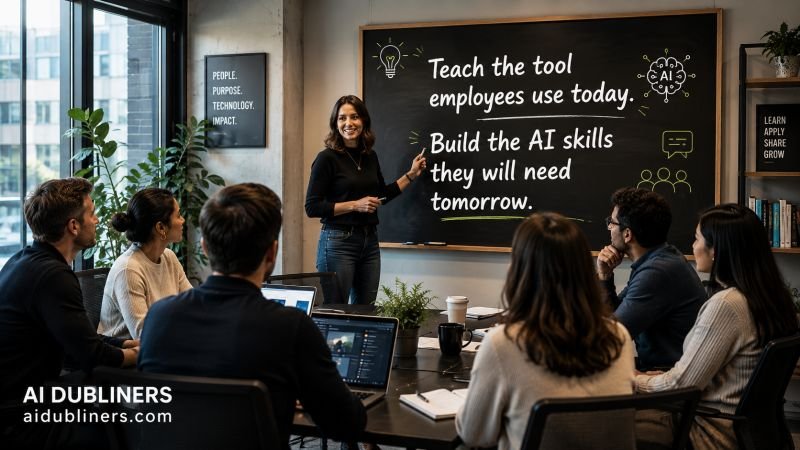
First, it should teach employees the features, workflows and safety rules of the tools they use today.
Second, it should build lasting AI skills that prepare them for the tools they may use tomorrow.
Products can change. Strong AI literacy should stay with us.
How should companies balance product knowledge with lasting AI skills?


