One of the most valuable ways for me to understand Dublin and Ireland’s AI ecosystem is by attending events, meetups and hackathons. Sometimes, a conversation at a company run or social gathering can teach me more than many business meetings.
I cannot attend every event. Still, seeing what people are building, hearing which problems they are discussing and sharing what I learn through AI Dubliners is incredibly valuable to me.
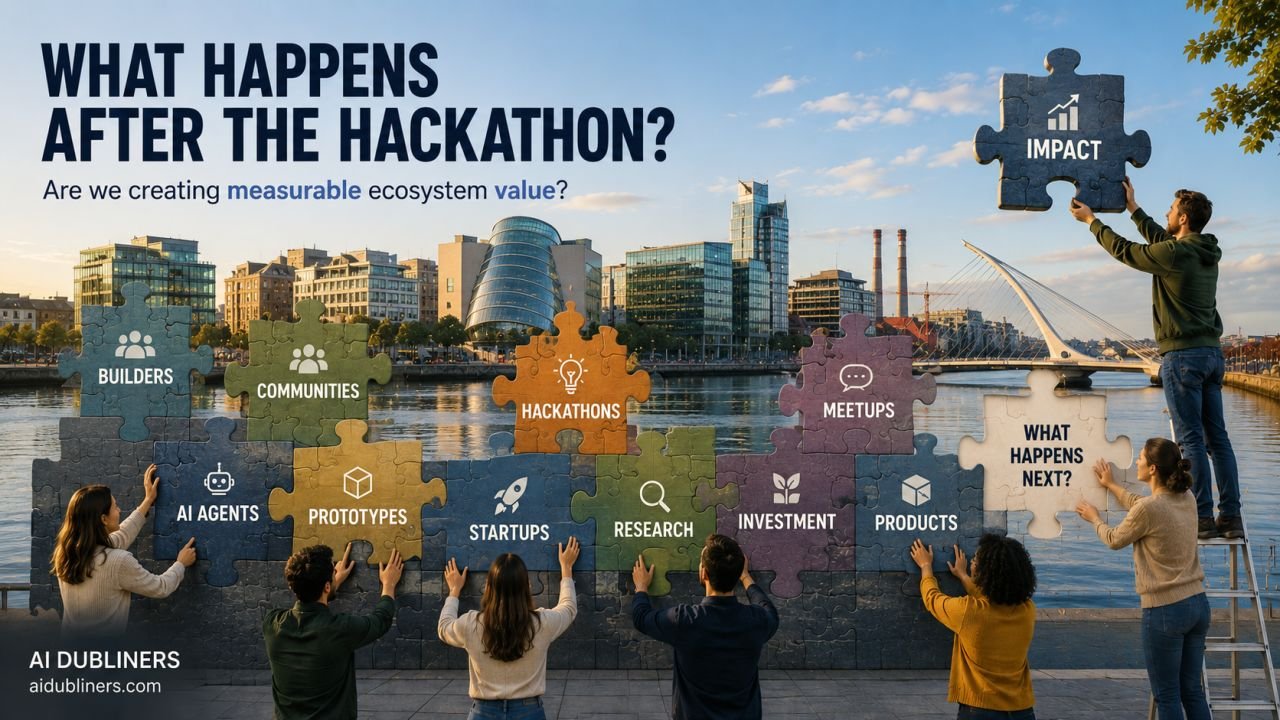
But I increasingly find myself asking: what happens after AI events in Dublin?
What is Dublin’s AI builder ecosystem producing?
We are no longer only talking about artificial intelligence. We are building products and tools with it. Ecosystem spaces such as Dogpatch Labs and Baseline, alongside active builder communities including Give(a)Go and AI Tinkerers Dublin, are important parts of this movement.
At the Agentic GTM Hackathon organised by Give(a)Go with OpenAI and Unify, teams built AI agents, automations and internal tools for real sales and growth problems.
At Dublin’s Manus AI for Good event, more than 50 builders created 33 working projects in a single evening. At the Claude × Supabase Dublin meetup, the talks were followed by a 30-minute build challenge.
These examples clearly show the energy within Dublin’s AI ecosystem. This momentum will become even more visible during Dublin AI Week, taking place from 2 to 9 October 2026.
How should we measure the success of AI events?
Participant, event, demo and prototype numbers show us activity. Impact becomes visible six or twelve months later.
We should also track:
- How many prototypes are still being developed?
- How many have found real users or customers?
- How many have reached a pilot, production or revenue?
- How many have become lasting products, teams or companies?
- How many builders found a new job, collaborator or investor connection?
Event metrics show us the activity in the room. Impact metrics show us what remained after it.
How can prototypes continue after the event?
I do not think we need fewer events. I think we need a stronger continuation system: 30, 90 and 180-day follow-ups, mentoring, access to users, small development grants, technical resources and opportunities to demo again.
Through AI Dubliners, I will continue following these events and the people building at them. But I want to document not only what was created on the day, but also where those ideas go afterwards.
As Dublin’s AI community, what should we measure six or twelve months later?


