There may never have been a more exciting time to build an AI startup in Ireland.
New artificial intelligence models are being developed. Product development costs are falling. Accelerators, universities, investors and a growing AI ecosystem are supporting entrepreneurs.
An idea emerges.
A team forms.
A product is built.
The first customers arrive.
But what happens next?
I have been thinking about this question more often lately. Because starting a company and growing it sustainably are two very different stages of the same journey.
Starting and growing are not the same thing
The early stage is usually the most visible part of a startup story.
A new idea, the first investment, a product launch or the first customer naturally creates excitement. The founders’ energy, the problem they want to solve and their vision for the future make the story interesting.
But once the initial excitement fades, more difficult questions begin to emerge.
Does the product genuinely meet a market need?
Do customers continue using it?
Is the revenue model sustainable?
Can the company enter new markets?
Does it have the resources to hire the right people?
This is where a less romantic but crucial word enters the startup story: scaling.
Developing a strong idea is one thing. Turning it into a sustainable and growing company is another.
What remains after the initial excitement?
AI Dubliners began with a very simple curiosity:
“What is artificial intelligence, and what is happening around it in Ireland?”
I started researching because I wanted to learn.
That journey introduced me to AI companies, products, founders and businesses using artificial intelligence across different sectors in Ireland. I began exploring their work and sharing their stories through AI Dubliners.
More than a year later, I can now look back at some of the companies I previously covered.
Some are raising investment, entering new markets, winning customers and growing their teams. Seeing their progress motivates me too.
But not all of them follow the same path.
Some pivot. Some become quieter over time. Sometimes, the excitement I saw at the beginning appears to fade.
This does not always mean failure. A startup may change direction, enter a quieter period of product development or focus on a different market. All of these can be natural parts of the journey.
Still, the same question remains:
How does a startup continue once the initial excitement is gone?
AI Dubliners is facing a similar question
I cannot ask this question only of the companies I follow. I also need to look at AI Dubliners.
For more than a year, I have been building a platform that has introduced me to dozens of companies, founders and people across the ecosystem. I research, create content and try to make Ireland’s AI ecosystem more visible.
However, AI Dubliners has not yet become a platform that generates direct revenue.
Does that make it unsuccessful?
I do not think there is a simple answer.
Growth is not measured only by revenue. The trust you build, the knowledge you gather, the relationships you develop, the companies you help make visible and the opportunities that emerge over time are all part of the journey.
But the question of sustainability does not disappear.
I am not comparing AI Dubliners directly with a venture-backed technology startup. Yet, on a much smaller scale, I am facing a similar question:
Once you learn how to start something, how do you grow it?
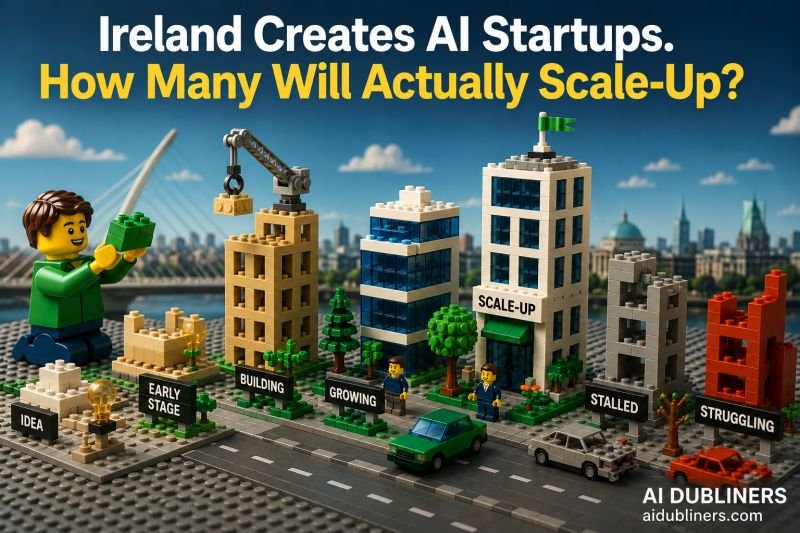
Ireland’s real challenge is moving from startup to scale-up
For Ireland, this question has much greater economic implications.
According to figures published by Enterprise Ireland in May 2026, the organisation supported 198 new startups in 2025 and invested a total of €32.9 million in these companies. The same announcement states that artificial intelligence was at the core of the product or service for nearly half of the startups supported.
These figures demonstrate the strength of AI entrepreneurship in Ireland.
But creating new companies does not necessarily mean those companies will be able to scale over the long term.
The Market Demand for and Supply of Scaling Finance in Ireland report, published by Ireland’s Department of Enterprise, Tourism and Employment, estimates an equity financing gap of approximately €1.1 billion over the next three to five years for Irish companies seeking to scale and expand internationally.
According to the report, this gap is particularly visible in funding rounds of between €5 million and €10 million, in the stages following Series A and especially at Series B and beyond.
In other words, Ireland may be strong at helping companies get started. The main difficulty emerges when those companies begin trying to grow internationally.
Capital matters, but it is not enough on its own
The financing gap is an important part of the scaling challenge. But access to capital is not the only issue.
The department’s research also identifies other barriers, including companies raising insufficient capital at an early stage, failing to reach the growth milestones required for later investment, a shortage of experienced people capable of managing advanced funding rounds and some Irish businesses asking for less funding than they actually need.
This shows that scaling is not simply about raising more money.
The right market, a strong product, experienced teams, international connections, patient capital and strategic decisions made at the right time must all work together.
Ireland is also trying to respond to this need. The government’s 2026–2030 Sectoral Capital Plan allocates approximately €1.12 billion to support indigenous companies in starting, growing and scaling. This includes a new €100 million Scaling Fund for Irish SMEs.
This is an important step. However, real success will not be measured only by the amount of funding allocated. It will be measured by how many companies grow sustainably, enter international markets and retain their headquarters in Ireland.
The real question is not how many startups are created
Perhaps the main question Ireland should be asking is not:
How many new AI startups will be created?
A more meaningful question might be:
How many of them will become genuine scale-ups?
For AI Dubliners, this article is also a reminder to myself.
Growth does not always happen quickly. It is not only about revenue. It requires patience, time, the right conditions and, above all, continuing to create value.
I do not yet know exactly where this journey will take me.
But I will continue exploring Ireland’s AI ecosystem, learning and building AI Dubliners with the same curiosity and motivation I had at the beginning.
Because perhaps the first step towards scaling is remembering why you started.