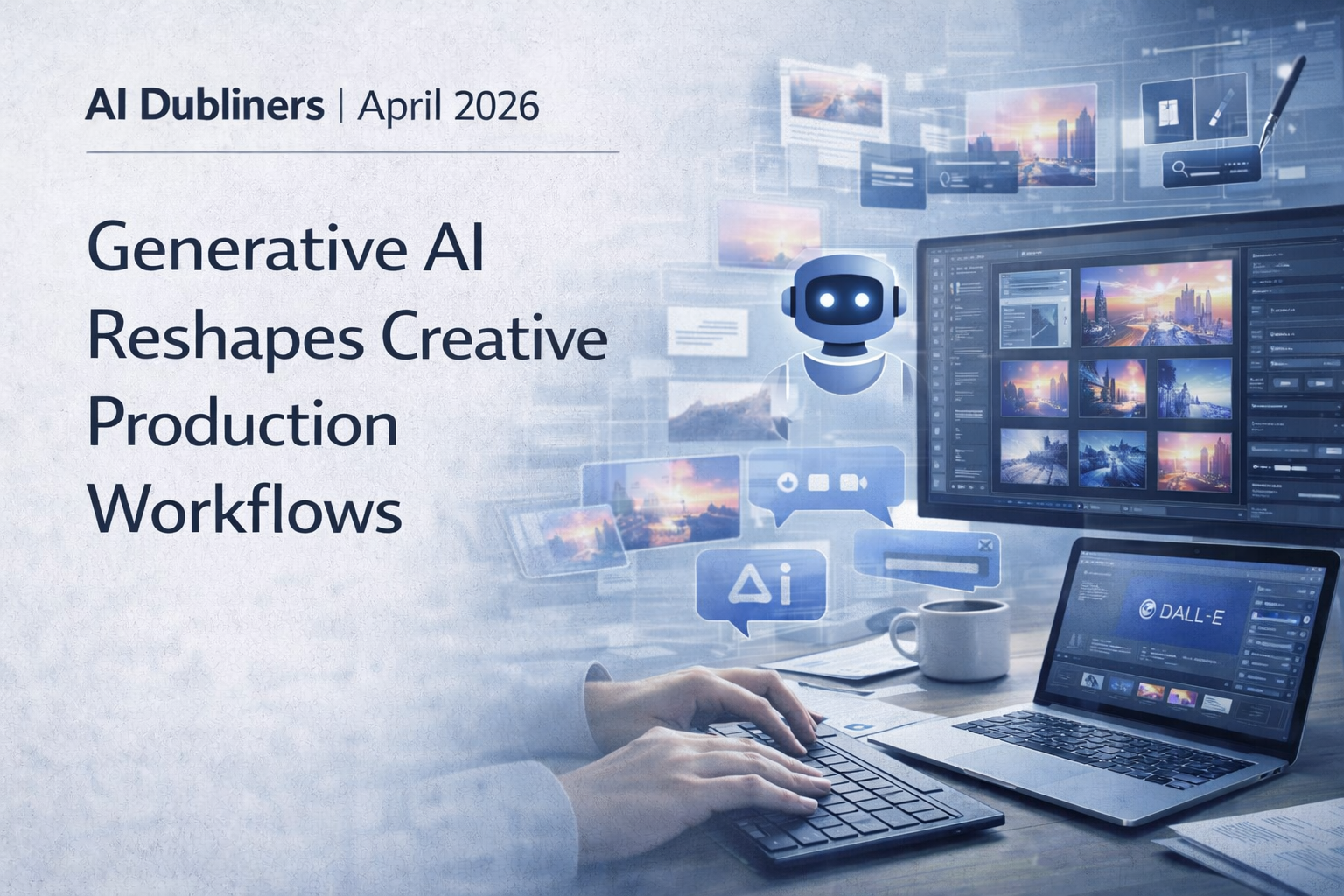
Generative AI is beginning to reshape creative production in a very practical way.
Across design, marketing, video, image creation and branded content workflows, new tools are helping individuals and teams move faster from idea to output. What once required multiple tools, long editing cycles or manual asset creation can now be accelerated through AI-assisted generation, editing and iteration.
That is changing how creative work gets done.
From creation to workflow acceleration
The biggest shift is not simply that AI can generate images, text or video.
It is that creative platforms are increasingly being designed around end-to-end workflows.
Companies such as Adobe are expanding generative AI beyond single prompts and into broader creative systems that support ideation, editing, production and style consistency. OpenAI’s image generation capabilities are part of the same broader movement, where generative models are becoming more useful not only for experimentation, but for practical creative output.
This means generative AI is no longer just a novelty layer on top of creative work. It is becoming part of the production process itself.
Why this matters for creative teams
For creators, marketers and production teams, the value is increasingly clear.
Generative AI can help teams:
- create assets faster
- explore more variations
- reduce repetitive production work
- accelerate early-stage ideation
- scale content output more efficiently
That does not mean creativity disappears. If anything, the role of human judgment becomes more important. Creative direction, taste, brand consistency and editorial decision-making still matter deeply. What changes is the amount of time and effort required to move from concept to execution.
Creativity is evolving, not vanishing
One of the most important misconceptions around generative AI is that it replaces creativity.
In reality, the stronger signal is augmentation.
These systems give individuals and teams new ways to experiment, iterate and produce work at greater speed and scale. They lower friction in the production layer, while leaving vision, selection and creative intent in human hands.
That is what makes the shift so significant.
What this means for Dublin
For Dublin, this is particularly relevant because the city sits at the intersection of technology, startups, creative industries and digital services.
As generative AI tools become more capable and more accessible, teams in Dublin can use them to improve output, reduce production costs and compete more effectively in global digital markets. This applies not only to agencies and creators, but also to startups, in-house marketing teams, media businesses and companies building creative technology products.
A wider signal
At AI Dubliners, we see generative AI as one of the clearest examples of how AI is moving from experimentation into everyday professional workflows.
The next phase will not be defined only by what these tools can generate. It will be defined by how well they fit into the way creative work actually happens.
And that shift is already underway.