As AI becomes more widely available, a bigger question is starting to matter:
Where will real value actually form?
Several developments over the past few days point back to that same issue. At first glance, they seem unrelated. One is about Anthropic’s latest model release. Another is about industry support for open-weight AI. Another is about Europe’s new transparency obligations under the AI Act. Another is about renewed US-China AI talks. And another is about Ireland’s growing regulatory role in the AI era.
Taken together, they suggest that the next phase of AI competition may not be defined only by access to the strongest model.
It may be defined by what companies, countries and institutions build around that access.
Anthropic’s latest release shows how model access is spreading
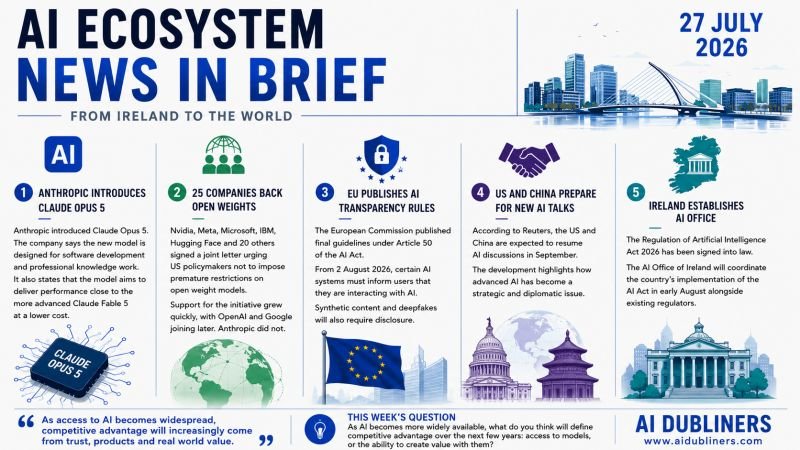
Anthropic introduced Claude Sonnet 5 on 30 June 2026, positioning it as its most agentic Sonnet model so far.
That matters because powerful AI capabilities are no longer limited to a tiny number of frontier products. They are increasingly moving into broader developer and enterprise use. As model access becomes more common, the competitive advantage may begin shifting away from raw model access alone.
The question becomes: what can organisations actually build with these systems?
Open-weight AI is becoming a bigger policy debate
That question became even more visible when 25 technology companies signed a joint letter warning policymakers not to impose premature restrictions on open-weight models.
This is an important signal.
For much of the last few years, the AI race focused on who could build the best models. But as open-weight systems become more capable, a second debate is growing around who should be allowed to access, modify and deploy them.
If powerful AI becomes more widely available, then access alone may no longer be enough to differentiate companies. Execution may matter more.
Europe is focusing on trust and transparency
At the same time, the European Commission has now published its final transparency guidelines under the AI Act.
From 2 August 2026, certain AI systems will need to make it clear that users are interacting with AI, while some forms of synthetic content will require disclosure.
This reminds us that AI is no longer just a product or infrastructure story.
It is also a trust story.
And in Europe, trust is increasingly being built through regulation, documentation and visible accountability.
AI is also becoming a diplomatic issue
According to Reuters, the United States and China are preparing for new AI talks in September 2026.
That matters because it shows how advanced AI is no longer only a race between companies. It is now part of strategic diplomacy between states.
The future of AI will be shaped not only by product releases, but also by the rules, negotiations and geopolitical pressures surrounding them.
Ireland is moving in the same direction
Ireland is also becoming more visible in this landscape.
The Regulation of Artificial Intelligence Bill 2026 is advancing the creation of the AI Office of Ireland, which is intended to coordinate the country’s implementation of the AI Act alongside existing regulators.
This is an important shift.
Ireland is no longer only hosting major technology companies. It is also building the governance infrastructure that will shape how AI is applied, supervised and trusted in practice.
AI Dubliners perspective
Taken together, these stories point to the same conclusion.
As AI becomes more widely available, the next competitive advantage may not come from access to the best model alone.
It may come from:
- building products people genuinely want to use
- earning trust
- combining AI with domain expertise
- creating better user experiences
- solving real-world problems
At AI Dubliners, that feels like the bigger signal.
The real value in the next phase of AI may not sit in the model itself.
It may sit in what people build with it.