New AI startups are emerging in Dublin. Technology companies are expanding their investments, more capable models are being released, and employees are receiving training on tools such as ChatGPT, Copilot, and other AI assistants.
At first glance, everything seems to be moving in the right direction.
But one important question remains:
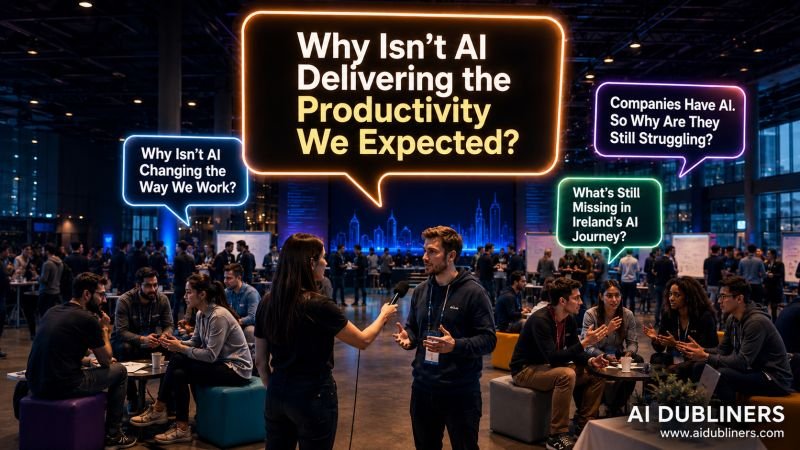
Is all of this genuinely changing the way we work, or are we simply using more AI tools?
AI Adoption Is Growing, but What About Business Results?
AI adoption is accelerating in Ireland.
According to Central Statistics Office data, the percentage of businesses using AI increased from 8% in 2023 to more than 20% in 2025. Among large businesses, the figure reached 58%.
These numbers indicate significant progress. However, they show that companies are using AI, not how much productivity or revenue that use is generating.
An employee may write an email faster with AI. But if the same task still involves lengthy approval processes, repeated data entry across different systems, or delays caused by unclear responsibilities, saving a few minutes may not create meaningful change across the organisation.
Using an AI tool and generating measurable business value are not the same thing.
Why Isn’t Training Enough on Its Own?
Employees need to learn how to use AI tools effectively. However, purchasing a few licences and providing prompt training does not automatically transform a company into an AI-driven organisation.
Meeting notes from Ireland’s Enterprise Digital Advisory Forum also indicate that businesses are at different levels of digital maturity, may struggle to access AI support, and need more meaningful indicators to measure progress.
Training can show employees how to use a tool. But it cannot answer these questions on its own:
- Which processes are genuinely suitable for AI support?
- At which stages should human judgement remain essential?
- How will success be measured through time, cost, quality, or revenue?
- Is the data being used secure and lawful?
- Who will take responsibility for incorrect results?
When these questions remain unanswered, AI becomes another layer added on top of existing systems rather than an integrated part of business processes.
The Missing Link May Be Organisational, Not Technological
To generate productivity from AI, organisations first need to understand the work itself.
Where is time being lost? Which tasks are repetitive? What information do employees need to make decisions? Should AI support the entire process or only one particular step?
For this reason, genuine transformation cannot be the responsibility of technology teams alone.
Operations, human resources, legal, data security, and leadership teams must also be involved. Only then can an AI strategy be connected to daily workflows, employee needs, and business goals.
Is Governance the Opposite of Productivity?
AI governance is sometimes viewed as an additional compliance burden that slows innovation.
However, without clear responsibilities, approved use cases, and reliable data policies, employees may not know which tools they are allowed to use. Projects may become stuck in lengthy approval processes, while uncontrolled experimentation can create new risks.
Good governance does more than reduce risk. It can also make AI adoption safer, more consistent, and easier to scale.
As EU AI Act obligations are gradually implemented, the newly established AI Office of Ireland will play a central role in coordinating the country’s regulatory approach.
These developments show that Ireland’s AI conversation is no longer focused solely on building models.
What Does Ireland Need Next?
Ireland is in a strong position when it comes to technical talent.
According to the government’s research on AI and the workforce, the number of AI-related job postings has doubled since 2023, while Ireland ranks highly in international comparisons of AI talent concentration.
More engineers and data specialists will certainly be needed.
However, the most valuable professionals in the coming years may not only be those who build AI systems. People who can bridge the gap between technology and business may become equally important.
AI strategy, process transformation, governance, and change management all come together at this point.
The next competitive advantage may not come from having the largest number of AI tools or the most powerful model.
It may belong to organisations that can integrate AI into the right processes, measure its results, and use it safely across the entire business.
What do you think is the next missing piece in Ireland’s AI ecosystem?
More engineers?
Or more professionals who can turn AI into genuine business value?


