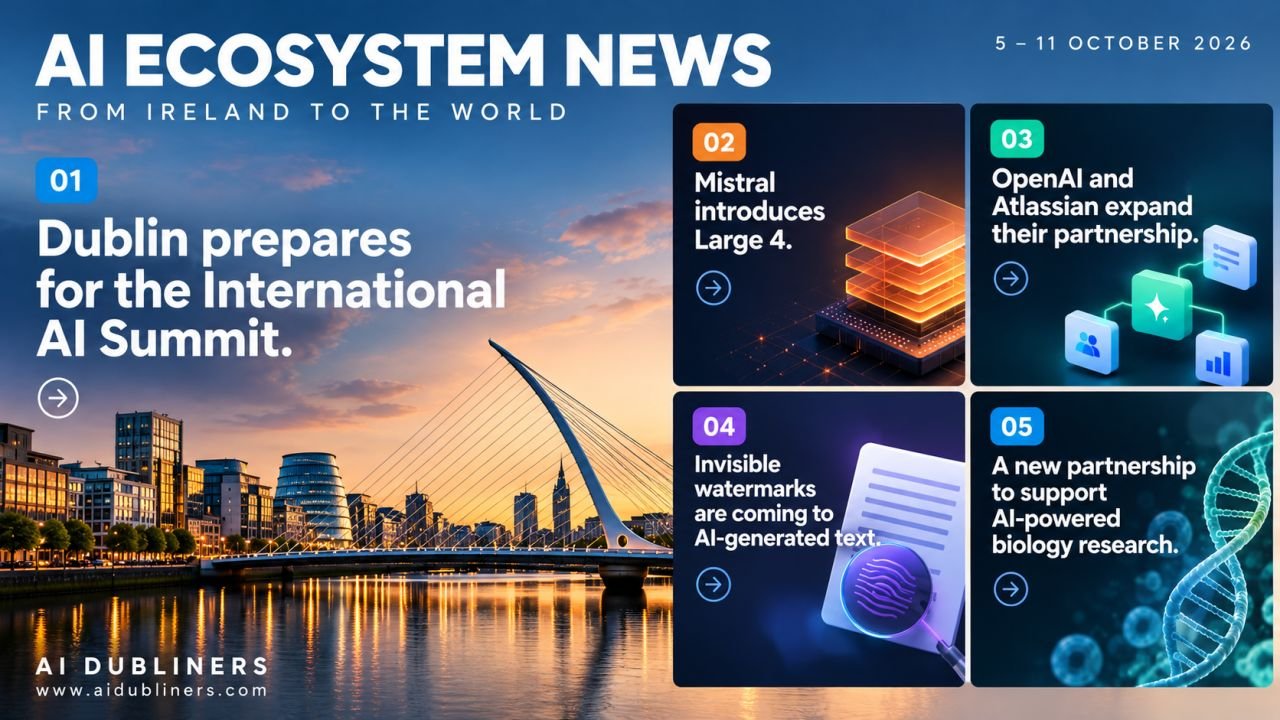
Last week, I brought together five AI developments that caught my attention while reading and researching. From Dublin’s upcoming International AI Summit to new models, enterprise integrations, content transparency and biology research, there was plenty to follow between 5 and 11 October 2026.
Perhaps you missed a few of these stories too.
Dublin Prepares for the International AI Summit
On 6 October, the Irish government announced the programme for the International AI Summit 2026. The event will take place at the RDS in Dublin on 14 October as part of Ireland’s Presidency of the Council of the European Union.
Speakers include Demis Hassabis from Google DeepMind, Sarah Friar from OpenAI and Brad Smith from Microsoft. Discussions will cover Europe’s AI competitiveness, critical infrastructure, enterprise transformation and AI skills. www.enterprise.gov.ie
While following Ireland’s AI ecosystem, I find it interesting to see practical adoption, skills and trust sharing the agenda with technological advances.
Read the official summit programme announcement.
Mistral Introduces Large 4
French AI company Mistral released a public preview of Mistral Large 4 on 6 October.
According to the company, the model has one trillion parameters and offers advanced capabilities in coding, AI workflows involving multiple steps and visual understanding. Mistral also highlights its performance in cybersecurity, finance and law.
The company plans to release the model weights by the end of October. Access to the preview and access to the model weights are therefore separate developments at this stage. mistral.ai
Read Mistral’s Large 4 announcement.
OpenAI and Atlassian Expand Their Partnership
OpenAI and Atlassian announced an expanded partnership on 6 October. OpenAI models will power AI agents across Atlassian’s platform, including Rovo.
The collaboration focuses on connecting AI models with a company’s projects, documents and decisions. For example, Rovo could draw on Jira tickets and Confluence documents to help assess whether a product is ready for launch. openai.com
This caught my attention as another example of AI becoming more integrated into everyday business workflows. Its usefulness depends partly on how well it can understand the context in which a company operates.
Read the OpenAI and Atlassian partnership announcement.
Invisible Watermarks Are Coming to AI Text
On 5 October, OpenAI announced plans to introduce invisible watermarks in eligible ChatGPT and Codex text outputs in the European Union over the coming weeks.
The approach responds to transparency requirements under the EU AI Act. It adds an invisible statistical signal to the model’s word choices, helping a detector identify whether a passage contains an OpenAI watermark.
However, the technology has limitations. Detection can become less reliable when text is short, edited or translated. The absence of a detected watermark does not prove that a human wrote the text. A watermark also does not verify accuracy or measure how much a person contributed. openai.com
For me, the distinction matters: a signal about where content came from should not be treated as a complete judgement about that content.
Read OpenAI’s approach to text watermarking.
A New Data Partnership for AI Biology Research
On 7 October, the US Department of Energy, the National Institutes of Health (NIH) and Biohub signed a memorandum of understanding to develop a data foundation for predictive models of biological systems.
The partnership brings together computing resources, health data, imaging capabilities and biomedical research infrastructure. Its goal is to create an open biological data foundation that helps researchers understand how cells respond to different interventions. www.energy.gov
This announcement represents a step towards infrastructure for future research, rather than a completed scientific breakthrough.
Read the US Department of Energy announcement.
What Stayed With Me From the Week
These five AI developments cover different areas. Some introduce new capabilities. Others address how AI connects with business processes, how generated content can be identified or which data will support future scientific research.
These are the stories that stood out to me while reading, researching and learning through AI Dubliners.
What caught your attention? Did I miss anything worth adding?