
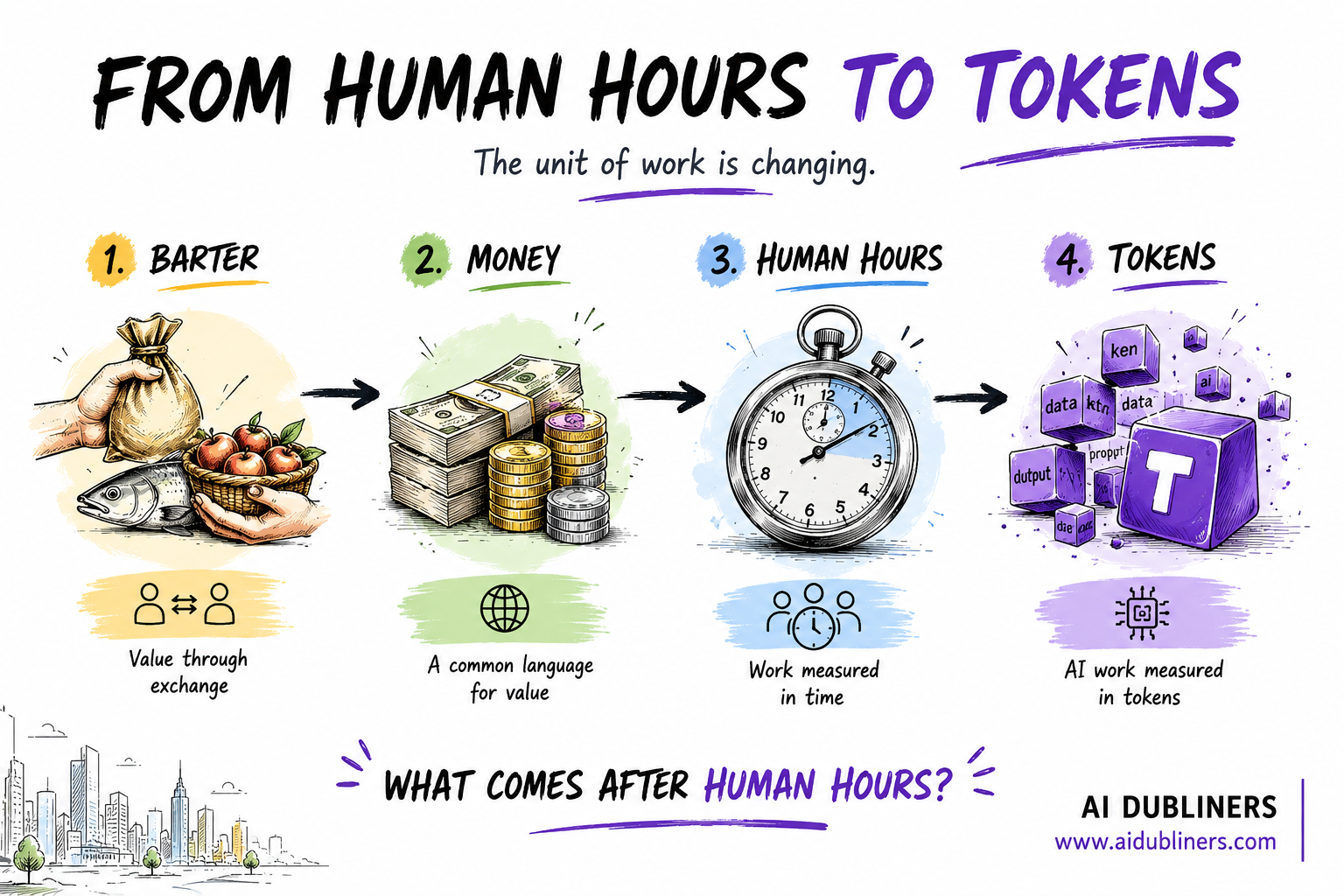
For most of modern economic history, work has been measured in human time.
How many hours will this take?
How many hours can a team deliver?
What is the hourly value of a consultant, analyst or employee?
That logic shaped the industrial economy and much of the digital economy that followed.
But in the age of AI, a new unit is beginning to matter:
tokens
Tokens are one of the fundamental units AI systems consume when processing inputs and generating outputs. Every prompt, response, document analysis and image generation task uses a certain number of tokens. In simple terms, if human work is often priced in hours, AI work is increasingly priced in tokens and compute.
That matters more than many organisations still realise.
Why tokens matter
For many teams, tokens still sound like a technical detail. But they are increasingly becoming a business input.
As AI usage grows inside companies, token consumption grows with it. More prompts, more analysis, more automations and more outputs usually mean more resource usage. That creates a new management layer for organisations already balancing labour costs, software subscriptions and cloud spending.
In other words, token usage is starting to become something companies need to monitor, not just engineers.
A new economic shift
This is where the AI economy starts to look different from the systems that came before it.
When a company asks a human to complete a task, the cost is often measured in time. When a company asks an AI system to complete a task, the cost is increasingly measured in tokens, model pricing and context usage.
That does not mean human labour becomes irrelevant. It means a second productivity layer is being added alongside it.
And that second layer comes with its own unit of cost.
Three shifts to watch
Several changes are already making this more important.
1. Token deflation
AI capabilities are becoming more affordable over time.
For the same budget, companies can often get far more output than they could even a short time ago. While human labour costs continue to rise in many markets, the cost of AI usage is often moving in the opposite direction.
2. The context window race
Organisations once focused on human reading and analysis capacity.
Now attention is shifting toward how many tokens AI systems can process in a single context window. As models handle larger and larger token volumes, they become more useful across research, operations, customer service and knowledge work.
3. Token budgeting
In the near future, token management may become as important as software licensing or workforce planning.
As companies scale AI-powered operations, they may need to allocate token budgets in the same way they allocate team budgets, infrastructure spend or tool subscriptions.
Why this matters for organisations
The real shift is not only that AI can generate smarter outputs.
It is that businesses are beginning to work with a second source of productivity alongside human labour. That changes how cost, efficiency and scale may be measured.
The question companies ask may start to evolve.
Alongside How many hours will this project take?, they may increasingly ask: How many tokens will this project consume?
The organisations asking that question early may be better prepared for the next phase of AI adoption.
AI Dubliners perspective
At AI Dubliners, we see this as one of the more important strategic shifts inside the AI economy.
Because the future of AI is not only about better models. It is also about understanding the new units of cost, value and operational planning that come with them.
In the AI era, it is no longer only human time that is being measured.
Computational power is being measured too.
And tokens are becoming one of the key units of that new economy.


