At a recent Trinity College Literary Talks session in Dublin, moderated by academic and writer Gülfem Pamuk, the discussion began with a literary question but quickly opened up something larger. The guest was Nermin Mollaoğlu, founder of Kalem Agency, who joined the session titled What Language Does Literature Speak?
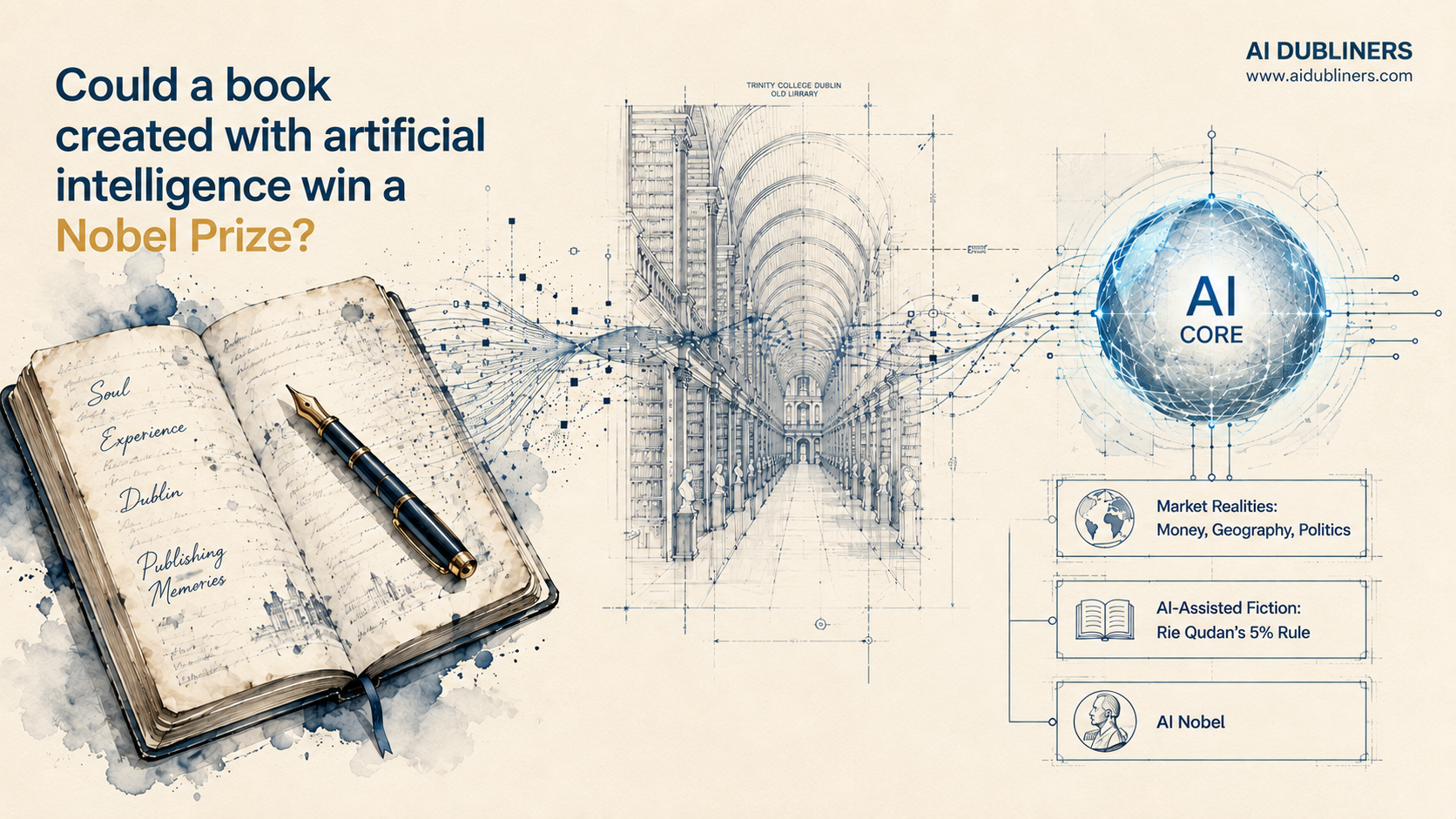
At first, the title might have suggested a more romantic conversation about books and writing. Instead, the discussion offered a sharper and more grounded perspective on the world behind literature. Mollaoğlu’s answer to the central question was strikingly direct: literature, she suggested, also speaks the languages of money, geography and politics.
That framing mattered.
It reminded the room that literature does not exist outside systems. Publishing, translation, rights, distribution and visibility are all shaped by professional and market realities, even when the final work feels intimate or timeless.
For AI Dubliners, however, the most interesting part of the evening came from a different angle: what happens when literature meets artificial intelligence?
Literature, authorship and AI
As AI becomes more involved in creative work, new questions are starting to emerge across art, film, publishing and writing.
One of the most compelling is this:
Could a book written with AI ever win a Nobel Prize in Literature?
From a formal standpoint, the answer today appears clear. Nobel Prizes are awarded to human individuals, and in some cases to organisations, not to AI systems.
But the more interesting question is not legal. It is creative.
What happens when a writer uses AI to develop plot ideas, analyse characters or generate parts of a text, and then shapes the final work through their own editorial judgment, voice and vision?
This is no longer a purely theoretical question.
In January 2024, Rie Qudan, winner of Japan’s prestigious Akutagawa Prize, publicly said that around 5% of her novel Tokyo-to Dojo-to (The Tokyo Sympathy Tower) had been generated with ChatGPT. She described AI as something that helped her work through creative blocks and move past mental barriers during the writing process.
That example does not prove that AI-written literature is about to win the Nobel Prize. But it does make the question harder to dismiss.
A new literary question
The real issue may not be whether AI can replace the writer.
It is whether AI is beginning to enter the professional language of literature itself, as a tool, an assistant or even a creative partner.
That possibility sits at the intersection of authorship, originality and cultural value. And it suggests that the future conversation around AI will not only be about productivity or automation, but also about creativity, legitimacy and what society is prepared to recognise as meaningful work.
At AI Dubliners, we follow these signals closely.
Because AI is not only changing how businesses operate. It is also beginning to challenge how we think about authorship, creativity and the cultural systems built around them.
So the question remains:
Will the professional language of literature eventually include the logic and structure of AI as well?
If you’re interested, I wrote about this here:
Could an AI-Made Film Win an Oscar?


