Several AI developments over the past few days point back to the same deeper question:
To build trustworthy AI, do we first need to understand how it thinks?
At first glance, the stories seem unrelated. One is about new research into how an AI model reasons. Another is about wider enterprise access to that model. And another is about Ireland’s growing role in AI infrastructure, policy and adoption.
But taken together, they highlight the same tension: AI is moving into real-world use quickly, even as understanding of how these systems work internally is still evolving.
Anthropic’s new research points to an internal reasoning space
One of the most notable AI research developments this week came from Anthropic.
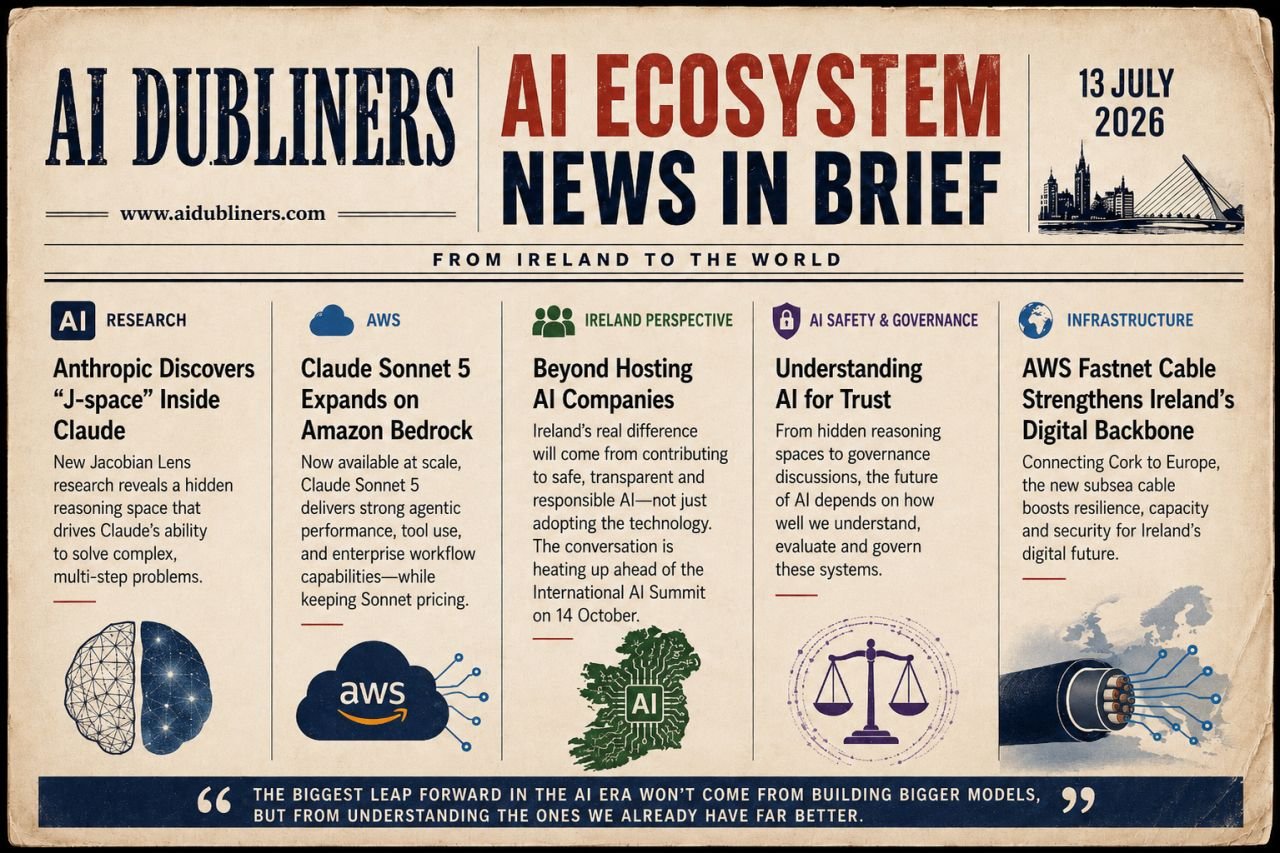
In a new paper, researchers introduced a method called the Jacobian Lens and described an internal reasoning space inside Claude referred to as J-space. According to the paper, this appears to be part of the model’s internal process for multi-step reasoning, mathematics and code-related problem-solving.
One finding stands out in particular.
When researchers disrupted this internal reasoning space, Claude remained fluent and kept much of its factual knowledge. However, its performance on more complex reasoning tasks dropped significantly.
That distinction matters.
It suggests that fluency and reasoning are not the same thing, and that understanding the internal structure of advanced models may become increasingly important for both AI safety and AI governance.
The research also found that when the model showed misleading behaviour, concepts related to fake and fraud appeared in this same internal space, opening another line of inquiry around how risky behaviour may be represented inside models before it appears in output.
AWS is expanding enterprise access to Claude Sonnet 5
That same week, AWS expanded the availability of Claude Sonnet 5 through Amazon Bedrock and the Claude platform on AWS.
This is the other side of the current AI story.
While one part of the field is trying to understand how models think, another part is rapidly putting those same models into enterprise workflows, products and agentic systems.
That creates an important contrast.
The more widely powerful models are deployed, the more valuable it becomes to understand how they reason, where they fail and what kind of internal structures may shape their behaviour.
Why this matters for Ireland
These developments also point back to Ireland.
Ireland already hosts the European operations of several of the world’s most important AI and technology companies. But hosting AI companies is not the same thing as helping shape trustworthy AI.
As the International AI Summit in Dublin approaches on 14 October, Ireland has a chance to strengthen its role not only in AI adoption, but also in AI safety, AI governance and AI-related research.
Infrastructure remains part of that picture too.
The AWS Fastnet subsea cable continues to underline the fact that AI is not built on models alone. It also depends on resilient infrastructure, connectivity, skilled people and long-term investment.
AI Dubliners perspective
At AI Dubliners, we see this week’s developments as two sides of the same story.
One side is about scale, access and deployment.
The other is about understanding, safety and control.
Perhaps the next real leap in AI will not come only from building bigger models.
It may come from understanding the ones we already have more clearly.